


Where a Molecule Learns to Behave: Process Development in Biologics for the CDMO Journey
In biologics, a promising molecule does not become a manufacturable product simply because its biology appears convincing in early discovery or preclinical work. A molecule may show strong binding, good potency, or a clear therapeutic rationale, yet still prove difficult to express consistently, difficult to purify without losses, or difficult to carry through scale-up without changes in product quality. That gap between molecular promise and manufacturing reliability is where process development becomes central. It is not an accessory to biologics development. It is the discipline that turns a laboratory candidate into a process-defined product that can be produced with consistency, control, and regulatory confidence.
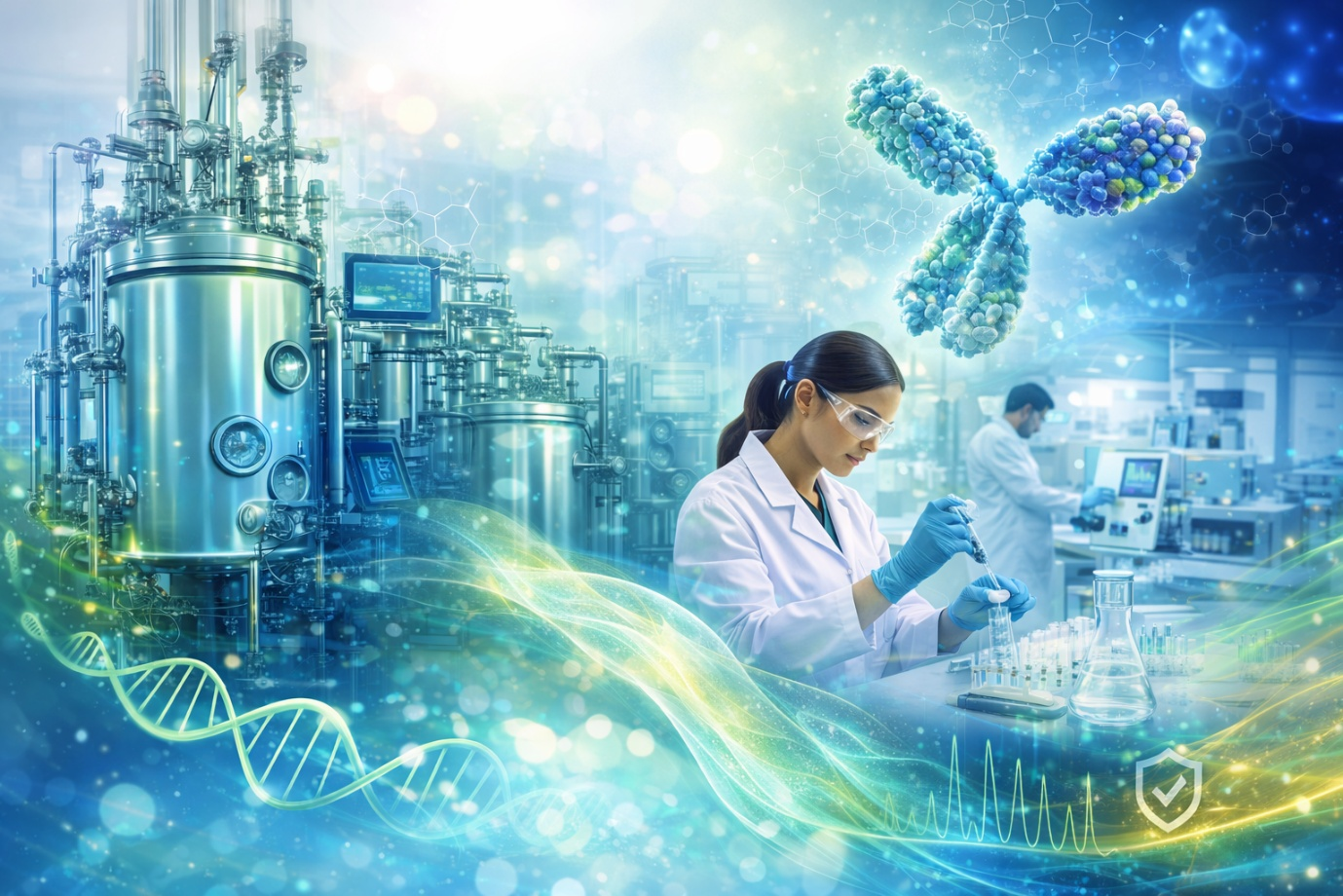
Figure 1. Integrated biologics process development across upstream production, downstream purification, analytical control, and manufacturing readiness.
At a scientific level, process development in biologics is shaped by a simple but demanding reality: in most biologic products, the process and the product are closely linked. Unlike many small molecules, biologics are generated through living systems and are therefore more sensitive to changes in the manufacturing environment. The choice of host cell, the composition of the culture medium, feeding strategy, dissolved oxygen, pH, temperature shifts, process duration, shear exposure, purification conditions, and hold times can all influence the final molecular profile. These influences may appear as changes in glycosylation patterns, charge variants, aggregation tendency, fragmentation, purity profile, or biological activity. In other words, the product is not defined only by its sequence. It is also shaped, in a very practical sense, by how it is made.
This is why process development occupies such an important place between scientific promise and manufacturing reality. It gives structure to a stage that might otherwise remain uncertain. It asks whether the molecule can be expressed at useful titres, whether the culture remains stable across passages and process conditions, whether impurities can be removed to the expected level, whether the purified material remains stable during downstream handling, and whether the whole route can be scaled without losing reproducibility. In many biologics programs, this work determines whether development moves forward with clarity or with avoidable technical risk.
From a CDMO perspective, process development is not merely a set of isolated experiments performed in sequence. It is the point at which multiple dimensions of the program begin to align. The molecule must fit the expression platform. The upstream process must generate material of acceptable quality and composition for downstream recovery. The downstream train must clear process-related and product-related impurities without damaging yield or molecular integrity. Analytical methods must be capable of detecting meaningful changes in critical quality attributes. The process must then be shaped in a way that supports scale-up, technology transfer, regulatory filing, and later manufacturing control. When this alignment is weak, the effects are felt quickly. A high expressing cell culture may still become a development problem if host cell proteins, DNA, aggregates, or variant forms are difficult to clear downstream. Equally, an elegant purification sequence may still fail commercially if the upstream process is unstable, low yielding, or too difficult to reproduce at larger scale.
This is why biologics process development is usually understood through two tightly connected arms: upstream and downstream. Upstream process development focuses on the production phase, where the goal is to establish robust cell culture or microbial expression conditions that can deliver the target molecule with appropriate productivity and quality. This may include cell line development, clone selection, media and feed optimisation, process parameter tuning, and evaluation of batch, fed-batch, or perfusion modes. Downstream process development begins once the molecule has been produced and moves into recovery and purification. Here, the work may involve clarification, capture, intermediate purification, polishing, viral clearance strategy, concentration, and buffer exchange, all guided by the need to balance purity, recovery, throughput, and product stability. Scientifically, these are distinct domains. Operationally, they are deeply interdependent.
That interdependence has made integrated development models increasingly valuable. Biologics sponsors today often prefer CDMOs that can view upstream, downstream, analytics, formulation interface, and manufacturing readiness as part of one connected development path rather than as separate service blocks. Aurigene’s biologics platform is positioned in that integrated manner, bringing together drug substance and drug product capabilities, upstream and downstream processing, fill-finish, single-use systems, process intensification, and manufacturing support within a broader development-to-production framework. The company also places process development within a setting informed by cell culture science, protein chemistry, and analytical support, with operating scales ranging from small development volumes to 1000-plus litres across batch, fed-batch, and perfusion systems.
Seen in this light, process development in biologics is best understood as the disciplined shaping of a manufacturing process around the scientific behaviour of the molecule. It is technical in method, but strategic in impact. It does more than generate material for the next study. It reduces uncertainty around the molecule, clarifies the path to scale, and builds the process understanding needed to support product quality over time.
Connect with our scientific experts for your drug discovery, development and manufacturing needs
The Scientific Spine of Biologics Process Development
What process development really means in biologics
Process development in biologics is the systematic design and refinement of the manufacturing route used to make a biological product such as a monoclonal antibody, fusion protein, cytokine, enzyme, or other recombinant therapeutic. The aim is not simply to get a product out of a system. The real aim is to build a process that is robust, reproducible, scalable, analytically understood, and suitable for regulatory submission and commercial control. This is especially important in biologics because the product is closely linked to the process. Small shifts in culture conditions, purification strategy, hold times, raw material quality, or equipment behaviour can alter critical quality attributes such as glycosylation, aggregation, charge variants, purity profile, or biological activity. FDA’s biologics guidance and ICH Q11 both reflect that process knowledge and control are central to assuring drug substance quality.
Upstream process development
Upstream process development covers the path from cell line or expression system choice to the generation of harvest material. In a mammalian program, that may involve clone selection, media and feed optimisation, bioreactor parameter setting, and the choice between batch, fed-batch, or perfusion culture. In microbial systems, the logic is similar, even though the biology, expression burden, and impurity profile may differ. The central question remains the same: how to make enough product, with the right quality, in a way that can be scaled and controlled.
The science here is more than raising titre. Cell growth, metabolism, nutrient demand, oxygen transfer, by-product accumulation, shear sensitivity, and product quality all interact. A process that gives a higher output in a shake flask may behave differently in a controlled bioreactor. Likewise, a feeding strategy that pushes productivity may also increase heterogeneity or stress-related impurities. This is why upstream development relies on platform knowledge, scale-down models, and data-rich studies rather than one-off optimisation. Perfusion and process intensification approaches are increasingly important because they can improve volumetric productivity and facility utilisation, but they also demand tighter process understanding and control. Aurigene’s process development materials and biologics manufacturing pages place clear emphasis on fed-batch, perfusion, process intensification, and single-use bioreactor systems across development and manufacturing settings.
Downstream process development
Downstream process development begins once the product leaves the bioreactor or fermentation stage and enters the purification train. For proteins and antibodies, this typically includes clarification, capture, intermediate purification, polishing, concentration, and buffer exchange, followed by the studies needed to understand impurity clearance, product recovery, and process consistency. The downstream train has to remove host cell proteins, DNA, aggregates, fragments, leachables where relevant, and process-related contaminants, while preserving the intended product form and function.
In biologics, downstream development is rarely a simple purity exercise. It is a balancing act between recovery, selectivity, scalability, resin performance, filterability, process time, and product stability. One chromatography sequence may give excellent purity but poor yield. Another may be scalable but too sensitive to feed variability. Viral clearance, hold time studies, and resin lifetime or reuse strategy also become important depending on stage and intended route to GMP manufacture. EMA’s biotechnology process validation framework explicitly includes upstream and downstream evaluation and verification, and Aurigene’s process development flyer lists downstream and upstream process characterisation, viral clearance, hold time study, and resin lifetime study as part of the overall offering.
Why upstream and downstream cannot be treated separately
In real biologics development, upstream and downstream are connected by product quality. The harvest generated upstream determines the impurity burden, the solids profile, the titer, and often the difficulty of purification. Downstream, in turn, affects which upstream compromises are acceptable. A process that looks strong in one department may create problems in the next. This is why integrated development models matter so much in a CDMO environment. Aurigene’s public biologics materials repeatedly present process development alongside analytics, process characterisation, formulation, and manufacturing support, rather than as an isolated activity.
Role of analytics and characterization
Biologics process development does not stand on process studies alone. It depends heavily on analytical development and process characterisation. Without suitable methods, it is difficult to understand whether a change in culture, purification conditions, or scale has actually improved the process or only shifted the problem elsewhere. Identity, assay, purity, charge variants, size variants, process-related impurities, and stability indicators all inform process decisions. CDMOs that integrate analytics into process development generally support faster decisions, stronger comparability packages, and cleaner technology transfer into GMP settings. Aurigene’s website and service materials put analytics, spent media analysis, multivariate process analytics, process characterisation, and broader in-house analytical support directly into the process development frame.
General Offerings in Biologics Process Development
Cell line and expression support
In biologics programs, CDMOs commonly support early expression-related work such as host selection, clone screening, stable pool development, clone stability assessment, cell banking support, and developability assessment. Even when the sponsor enters with a candidate molecule already defined, the manufacturability of that molecule still has to be tested in an expression context that supports quality and scale. This becomes especially important for engineered antibodies, multispecifics, fusion molecules, and other formats that may place more burden on expression systems. Aurigene’s public biologics flyer similarly describes support around cell line development, characterisation, manufacturability assessment, cell banking, and process design and optimisation.
Upstream process design and optimisation
A typical CDMO upstream offering includes media development, feed strategy design, parameter optimisation, scale-down experimentation, process intensification studies, and scale-up planning across batch, fed-batch, and sometimes perfusion formats. The goal is to build a process that is not only productive but also reproducible and suited to later manufacturing equipment. In strong CDMO settings, this work is supported by automated small scale systems, controlled bioreactor platforms, and structured data review to reduce scale related surprises later. Aurigene’s site and process development materials describe operation from millilitre scale to 1000 plus litres, along with fed-batch and perfusion expertise and flexible use of single use or stainless steel systems.
Downstream route development and purification strategy
CDMOs typically provide downstream process design beginning with clarification and extending through capture, polishing, viral clearance, and concentration steps. The exact platform varies by molecule, but the objectives are familiar: purity, recovery, robustness, and scale-up readiness. For antibody based products, affinity capture, ion exchange, hydrophobic interaction, mixed mode approaches, and membrane based operations are common elements in the toolbox. Process development teams also work on buffer strategy, resin loading, pooling logic, filterability, and step sequencing to make the purification train practical at manufacturing scale. Aurigene’s public materials list batch and continuous chromatography, affinity, HIC, mixed mode, viral clearance, and other characterisation linked studies as part of the broader process development landscape.
Analytical alignment and process characterisation
A biologics CDMO generally supports process development with analytical method development, impurity profiling, product quality assessment, comparability studies, and process characterisation work. This is where the process begins to generate defendable knowledge for CMC packages and later validation activities. Regulatory expectations do not stop at showing that a process works once. The process needs to be understood well enough to justify controls, ranges, and stage-appropriate decisions. EMA and FDA both reflect that lifecycle view of development and validation.
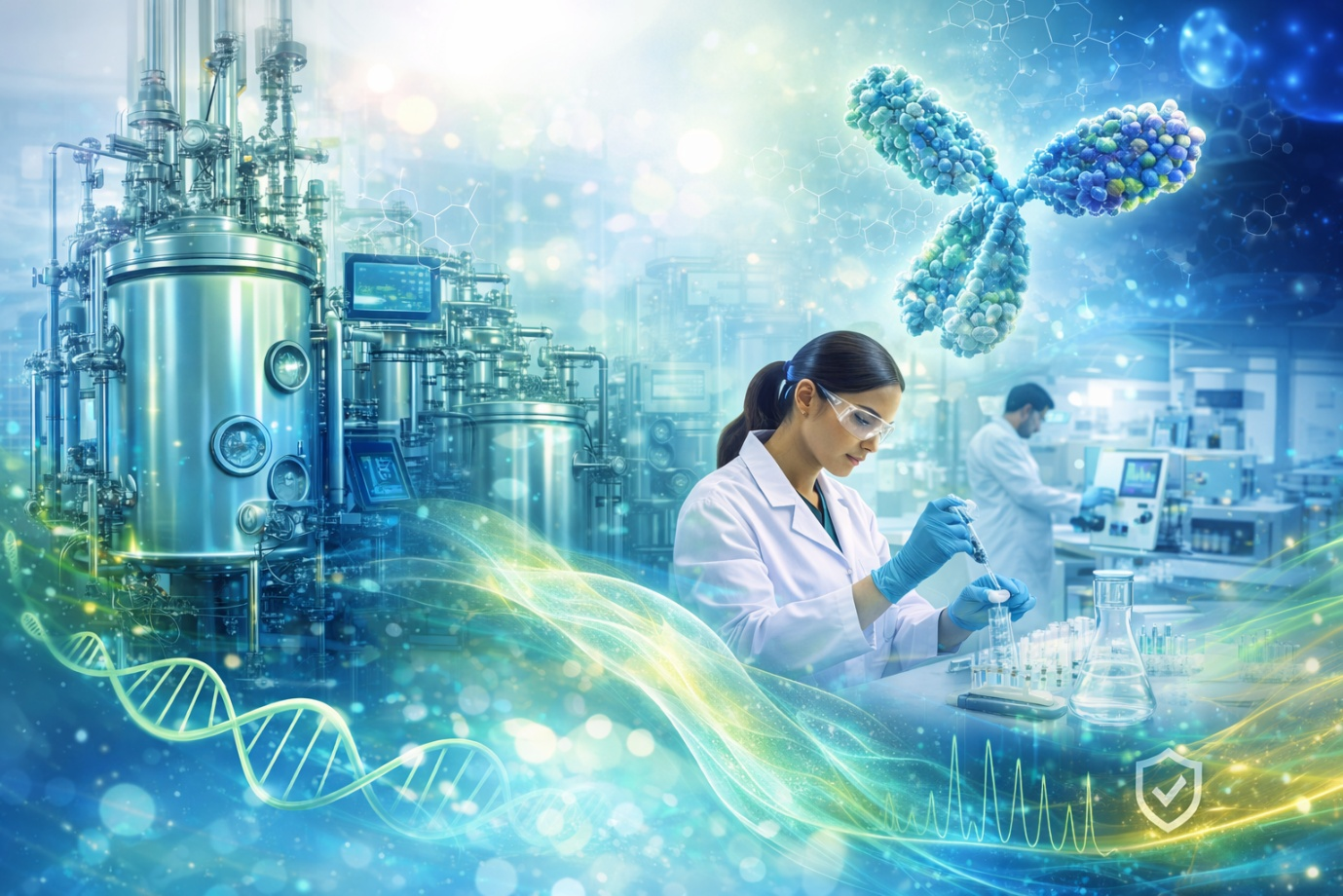
Figure 2. Upstream and downstream biologics process development, connected through analytical control and scale-up readiness.
Scale-up, technology transfer, and manufacturing readiness
Another standard expectation from biologics CDMOs is that process development should feed cleanly into non-GMP runs, engineering batches, GMP manufacture, and technology transfer. This calls for more than technical reports. It calls for platform fit, equipment mapping, raw material strategy, documentation discipline, and strong interaction between development and manufacturing teams. Aurigene’s own infrastructure pages emphasise integrated DS and DP operations, development to manufacturing continuity, and digital systems aligned with data integrity and regulatory filing expectations.
What Aurigene offers
Aurigene’s process development scope in biologics is presented as part of an integrated large molecule platform that connects upstream and downstream development with analytics, process characterisation, formulation, technology transfer, and manufacturing support. Public website material highlights end-to-end biologics capability, while the uploaded upstream and downstream service documents provide a more specific operating picture for this service area.
Upstream Process Development
Facilities
- AMBR systems
- Small bioreactors of 5 L and 10 L scale
- Single-use 10 L systems
- Single-use 50 L systems
- Pilot plant 200 L systems
- Expandable R&D and manufacturing capacity
Services
- Cell line development
- Stable pool development
- Monoclone generation and characterization
- Transient expression analysis in CHO cells
- Shake flask fed-batch evaluation
- Batch mode process development
- Fed-batch process development
- Perfusion process development
- Process intensification and concentration studies
- Cell bank preparation and characterization
- Developability and manufacturability evaluations
- IND-enabling and standalone module support
Specialties
- Mammalian and microbial expression systems
- CHO, HEK293, and E. coli platforms
- Monoclonal antibodies
- Bispecific antibodies
- Multispecific antibodies
- Fab fragments
- ScFv
- Proteins
- Complex biologics
- Signal peptide optimisation for higher titer expression
- Electroporation-based stable pool generation
- Controlled shake flask evaluation under temperature, CO2, and humidity conditions
- N-stage and N-1 stage intensification approaches
Downstream Process Development
Facilities
- Integrated downstream development environment linked to analytical and bioanalytical support
- Access to chromatographic, CE, spectroscopy, spectrometry, and bioanalytical platforms
- Downstream capabilities aligned with formulation and drug product development settings
- Supportive manufacturing readiness framework for later-stage programs
Services
- Downstream development
- Technology transfer to manufacturing
- Integration with formulation development
- Integration with drug product development
- Integration with analytical development
- Stage appropriate qualification support
- Method transfer to QC and validation support
- Product quality assessment support
- Stability linked downstream support
- Support for clinical and later-stage programs
Specialties
- Monoclonal antibodies
- Bispecific antibodies
- Biosimilars
- Peptides
- Complex biologics
- Purity and impurity method support
- Charge and size variant analysis
- Identity and assay support
- Evaluation of product-related variants and process-related impurities
- Functional assay support
- General characteristics assessment, including pH, osmolality, particles, appearance, and fill volume
- Alignment with liquid and lyophilised drug product presentations, including vials, prefilled syringes, and auto-injectors
- Integration with freeze-thaw, accelerated, stress, and in-use stability studies
Challenges and Future Outlook
Complex molecules, tighter expectations
Biologics process development has become more demanding because the molecules themselves have become more demanding. Monoclonal antibodies may still dominate commercial volume, but engineered antibodies, multispecifics, fusion constructs, and other recombinant formats can bring higher structural complexity, more difficult expression behaviour, and greater pressure on purification design. At the same time, regulators expect stronger process understanding, clearer control strategies, and development packages that support lifecycle validation and reliable transfer to commercial settings.
Speed versus depth of understanding
A common challenge in CDMO-led development is the pressure to move quickly without losing scientific depth. Sponsors often want shorter development timelines, faster entry into toxicology or clinic, and reduced spend in early stages. But a weak process rarely stays cheap. Gaps in clone stability, poor feed understanding, underdeveloped impurity control, or fragile step performance tend to reappear later as deviations, low recovery, comparability difficulty, or transfer delays. The better CDMO model is not simply fast execution. It is phase-appropriate execution with enough data to avoid expensive rework.
Scale-up and transfer risk
Scale-up remains one of the hardest parts of biologics development. Conditions that look stable in small systems may behave differently in larger vessels, different mixing environments, or different equipment trains. Downstream scaling brings its own difficulties around residence time, pressure limits, resin packing, membrane performance, and pooling strategy. This is why scale-down models, digital data capture, process analytics, and development teams that understand manufacturing realities are becoming more important than before. Aurigene’s public materials reflect this movement through their focus on digital infrastructure, process analytics, scale flexibility, and technology transfer-ready development.
The rise of integrated, data-rich development
The future direction is fairly clear. Biologics process development is moving toward tighter integration of upstream, downstream, analytics, and manufacturing science. High throughput screening, multivariate analysis, process intensification, single-use platforms, and more structured process characterisation are shaping how CDMOs build development strategies. Perfusion is likely to stay important where productivity and footprint matter. Single-use systems will continue to support flexibility, especially for multi-product environments and faster changeovers. Analytical integration will also deepen, because product quality decisions cannot be separated from process decisions in biologics. Aurigene’s process development and manufacturing pages already show that direction in practical terms through single-use systems, perfusion capability, integrated analytics, characterisation support, and connected DS to DP infrastructure.
A more connected CDMO role
The CDMO role in biologics process development is changing from service executor to development partner. This shift comes from the fact that biologics programs increasingly need cross-functional judgment early, when decisions about clone, process mode, purification route, analytical package, and manufacturing fit are still open. The stronger organisations in this space are the ones that can connect those decisions without making the development path heavier than it needs to be. In biologics, that kind of connection often decides whether a process merely works in the lab or actually holds together on the road to market.