

Flow Chemistry: Building Continuity, Control, and Confidence in Small Molecule Manufacturing
Small molecule drug substance development has always balanced speed, control, safety, and scalability. As pipelines become more diverse and timelines tighter, traditional batch chemistry often reaches its practical limits. Reaction scale up introduces variability. Heat and mass transfer become harder to control. Safety margins narrow when highly energetic or hazardous intermediates are involved. These challenges are not new, but their impact has become sharper as molecules grow more complex and regulatory expectations more stringent.
Flow chemistry has emerged as a pragmatic response to these pressures. Rather than replacing classical chemistry, it reshapes how reactions are executed, monitored, and translated from lab to plant. By running reactions continuously through precisely engineered reactors, flow chemistry allows better control over reaction conditions, improved reproducibility, and safer handling of challenging chemistries. For small molecule CDMOs, it is no longer viewed as an experimental technique or a niche capability. It has become a platform that supports development decisions across early discovery, route scouting, process optimization, and commercial manufacturing.
Within a CDMO environment, flow chemistry offers something particularly valuable: continuity. The same fundamental setup can be used to study kinetics at milligram scale, optimize conditions at gram scale, and translate those conditions toward kilogram manufacturing with fewer surprises. This continuity shortens development cycles and reduces the risk that a process will behave differently at scale than it did in the lab.
For pharma and biotech sponsors, the value is practical rather than theoretical. Faster development of robust routes. Improved impurity control. Enhanced safety for reactions that are difficult or risky in batch. Lower solvent and energy usage in selected cases. When integrated properly with analytical, process chemistry, and manufacturing teams, flow chemistry becomes less about equipment and more about decision making with confidence.
Connect with our scientific experts for your drug discovery, development and manufacturing needs
Flow chemistry in small molecule CDMO operations
What Is Flow Chemistry
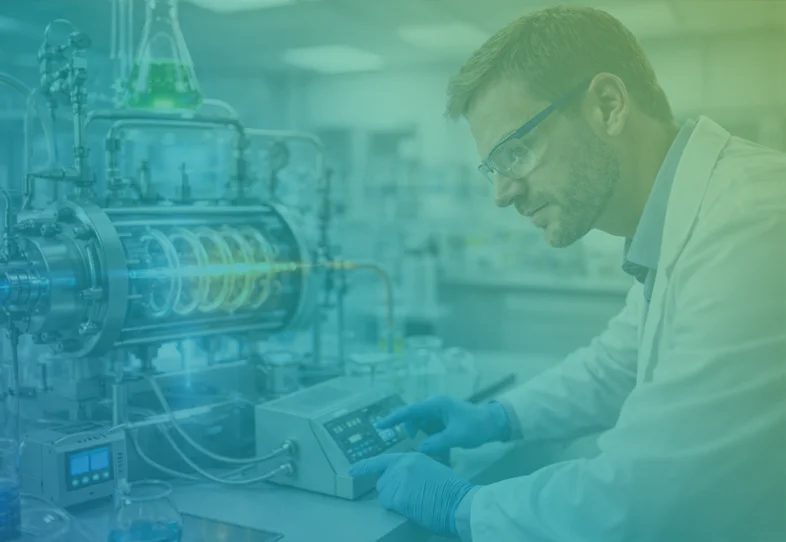
Flow chemistry refers to carrying out chemical reactions in a continuously moving stream instead of in a fixed batch vessel. In simple terms, reactants are pumped using controlled flow systems into a reactor, where the reaction takes place as the materials move through a defined channel or tube. The reactor can be a coil, a microreactor chip, or a tubular system made of metal, glass, or specialized polymers depending on the chemistry involved.
Key operating parameters such as temperature, pressure, flow rate, and residence time are tightly controlled. Residence time is the duration for which reactants remain inside the reactor. Because the internal volume of the reactor is small and the flow is constant, the system responds quickly to changes in operating conditions. Once the reaction mixture exits the reactor, it can be quenched, extracted, crystallized, or directly fed into the next step without stopping the process.
In a small molecule CDMO environment, the purpose of flow chemistry is not to showcase advanced equipment but to improve control, safety, and reproducibility. Many pharmaceutical reactions involve strong acids, oxidizing agents, high temperatures, or reactive intermediates. In a batch reactor, scaling such reactions can create heat accumulation, uneven mixing, or safety concerns. In flow systems, the small reaction volume and efficient heat transfer make it possible to run such reactions under controlled and safer conditions. Unstable intermediates can be generated and consumed immediately within the flow path, reducing exposure and decomposition risk.
Scientific rationale and core advantages
The scientific strength of flow chemistry is based on fundamental transport phenomena, mainly heat transfer and mass transfer.
In batch systems, heat generated during an exothermic reaction may not dissipate uniformly, leading to local hot spots. These hot spots can increase impurity formation or trigger runaway reactions. In flow reactors, the high surface area to volume ratio allows rapid heat exchange with the surroundings. This minimizes temperature gradients and keeps the reaction close to the desired set point.
Mass transfer is also more efficient in flow. Mixing happens quickly because of laminar flow characteristics and small channel dimensions. Uniform concentration profiles reduce localized excess of reagents, which helps control side reactions and impurity formation. Narrow residence time distribution means that most molecules experience nearly the same reaction time. This improves batch to batch reproducibility and supports consistent impurity profiles, which is critical for regulatory submissions.
Another important advantage is kinetic understanding. Since parameters like temperature and flow rate can be changed rapidly, reaction conditions can be screened systematically. Data can be generated across a range of residence times and concentrations in a short period. This helps in building reaction models and understanding rate limiting steps. Such knowledge supports robust scale up and justifies process parameters during regulatory filing.
Typical chemistry where flow adds value
Flow chemistry is particularly valuable when handling hazardous or reactive systems. For example, nitration reactions are highly exothermic and can be difficult to control in large batch reactors. In flow, controlled reagent addition and efficient heat removal reduce the risk of over nitration or thermal runaway.
Diazotization reactions often generate unstable diazonium intermediates. In flow systems, these intermediates can be formed and consumed immediately in the next step, reducing isolation risks. Similarly, oxidations and reductions involving strong oxidants, hydrogen gas, or metal catalysts benefit from improved safety and precise control of reaction conditions.
Photochemical reactions also gain advantage in flow reactors. Light penetration is more uniform in narrow channels compared to large batch vessels. This leads to better reaction efficiency and reduced side reactions.
Flow is increasingly used in telescoped multistep processes. In such cases, the output of one reaction is directly transferred into the next reactor without isolating the intermediate. This reduces solvent usage, saves time, and limits material loss. For small molecule CDMO operations, this approach supports faster development timelines and can improve overall process robustness while maintaining compliance with quality expectations.
General Offerings of CDMOs in flow chemistry
Route Scouting and Feasibility Assessment
In most established CDMOs and CRDMOs, flow chemistry is introduced at the route evaluation stage, not after full process lock in. During route scouting, development teams assess whether a specific transformation is better suited for batch or continuous mode. The decision is practical. It depends on reaction heat load, mixing sensitivity, reagent stability, impurity formation, and safety profile.
Feasibility studies are typically conducted at laboratory scale using modular flow reactors. These studies evaluate reaction stability over time, consistency of conversion, impurity generation pattern, and achievable throughput. CDMOs also assess clogging risk, solid formation tendency, compatibility of materials of construction, and solvent selection. The aim at this stage is not to maximize yield immediately but to define the operational window. This includes acceptable temperature range, pressure limits, concentration range, and residence time boundaries. Sponsors expect data driven justification before committing to a continuous process pathway.
In competitive CDMO markets, this early feasibility capability is increasingly seen as a differentiator because it reduces late stage surprises during scale up.
Process Development and Optimization
Once feasibility is established, process development teams move toward systematic optimization. Continuous systems allow fine tuning of parameters such as temperature, flow rate, stoichiometric ratios, and solvent composition. Because changes can be implemented quickly, multiple conditions can be screened in a short time.
Many CDMOs report improvements in space time yield when compared to equivalent batch processes. Higher concentration processing is sometimes possible due to improved heat removal. Narrow residence time distribution helps maintain tighter impurity control, especially for reactions prone to over reaction or decomposition.
Optimization work in flow also focuses on long term stability. The process must run consistently for extended hours or days without fouling, pressure build up, or performance drift. Market experience shows that regulators expect continuous processes to demonstrate steady state operation data, not only short laboratory runs. Therefore, CDMOs invest in extended runtime studies to confirm reproducibility before transferring the process to pilot scale.
Hazardous and High Energy Chemistry Handling
One of the strongest commercial drivers for flow chemistry adoption is safety. Many pharmaceutical intermediates require nitration, hydrogenation, azide chemistry, diazotization, or reactions involving toxic gases. In batch systems, scaling such reactions increases risk because large quantities of reactive material are present at one time.
Flow reactors operate with small internal volumes. Even if a reaction is energetic, the amount of material reacting at any given moment is limited. Continuous consumption of hazardous intermediates reduces accumulation risk. This has made flow chemistry attractive for handling diazonium salts, peroxides, high pressure hydrogenations, and gas liquid reactions.
From a CDMO perspective, this capability supports client programs that might otherwise require specialized containment or extensive safety engineering in batch plants. It also aligns with increasing regulatory and corporate focus on process safety and risk minimization.
Telescoped and Multistep Flow Processes
In recent years, CDMOs and cRDMOs have moved beyond single step flow reactions toward integrated multistep sequences. In telescoped processes, the output of one reaction is directly transferred to the next without isolating the intermediate. This approach reduces solvent usage, lowers handling losses, and shortens overall cycle time.
Market trends show increasing demand for such integrated solutions, especially in early clinical supply where speed is important. Telescoping also reduces exposure of sensitive intermediates to air or moisture, improving overall yield and impurity profile.
However, designing multistep flow requires careful compatibility assessment between steps. Solvent systems, temperature requirements, and reaction kinetics must align. Leading CDMOs therefore combine flow expertise with strong synthetic chemistry and analytical support to ensure that each step functions reliably within the integrated sequence.
Scale Up and Manufacturing Translation
Scale up in flow chemistry does not usually mean increasing reactor diameter significantly. Instead, scale is achieved by extending run time or by numbering up, which means operating multiple parallel reactors under identical conditions. This approach reduces the risk associated with geometric scaling seen in batch vessels.
CDMOs support translation from gram scale laboratory systems to pilot and commercial production using modular reactor skids or larger tubular systems. The advantage is continuity of design. If development and manufacturing reactors share similar geometry and operating principles, process transfer becomes smoother.
Regulatory documentation for continuous processes requires demonstration of steady state operation, control strategy definition, and understanding of start up and shut down phases. Experienced CDMOs incorporate this thinking early, aligning development data generation with later filing requirements.
Analytical Integration and Process Monitoring
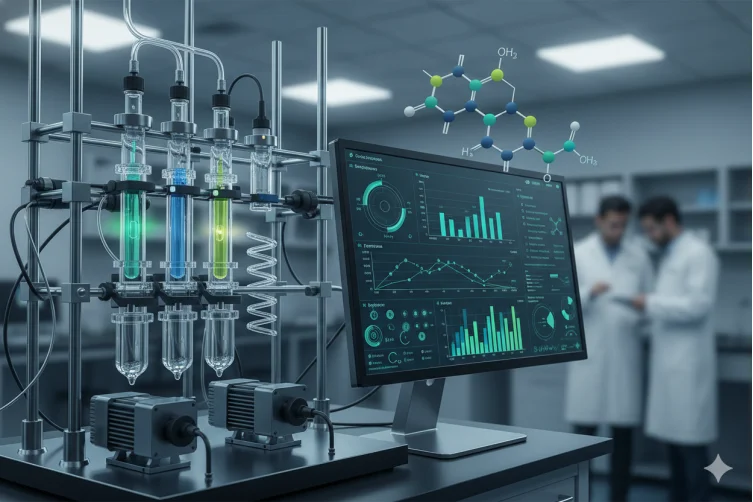
Continuous processes benefit strongly from integrated analytics. Inline or online tools such as FTIR, UV spectroscopy, Raman, or chromatography are increasingly used to monitor conversion and impurity levels in real time. This approach is aligned with process analytical technology expectations in modern pharmaceutical manufacturing.
Real time monitoring allows faster troubleshooting. If conversion drifts or impurity rises, corrective adjustments can be made quickly by modifying temperature or flow rate. Some CDMOs are moving toward automated feedback control systems where analytical signals directly adjust operating parameters.
Market research indicates that sponsors prefer CDMOs who can combine flow chemistry with strong analytical and regulatory understanding. Continuous manufacturing is not only about running reactions in flow. It requires an integrated system where chemistry, engineering, analytics, and quality teams work together to deliver consistent drug substance suitable for clinical and commercial supply.
What Aurigene offers
Aurigene approaches flow chemistry as an enabling platform within its small molecule development and manufacturing ecosystem. The focus remains on applying the technology where it meaningfully improves safety, robustness, or development timelines, rather than using it as a standalone showcase capability.
- Dedicated flow chemistry laboratories
- Modular reactor systems supporting high temperature and pressure operation
- Integrated analytical and process monitoring infrastructure
- Flow based route scouting and feasibility studies
- Process development and optimization under continuous conditions
- Translation of batch processes to flow where appropriate
- Support for pilot scale and commercial manufacturing strategies
- Handling of hazardous and highly exothermic reactions
- Telescoped multistep continuous processes
- Tight impurity control for regulated drug substances
- Integration of flow chemistry with broader CMC development plans
Challenges and future outlook
Technical and operational challenges
Although flow chemistry offers strong scientific and safety advantages, it is not suitable for every reaction. Some transformations depend on long reaction times, heterogeneous mixtures, or complex solid handling, which can be difficult to manage in narrow flow channels. Reactions that generate precipitates or involve poorly soluble intermediates may cause reactor fouling or blockage. Once fouling begins, pressure can increase quickly, affecting reaction stability and equipment safety.
Solid handling is one of the most practical limitations in continuous systems. Slurry reactions, crystallization steps, and salt formation can interfere with smooth flow. While newer reactor designs attempt to manage solids through wider channels or oscillatory flow, not all chemistries can be easily adapted.
Material compatibility is another scientific concern. Certain reagents such as strong acids, oxidants, or organometallic compounds may react with reactor materials. Selection of appropriate tubing, seals, and reactor bodies is critical. Glass, stainless steel, Hastelloy, and fluoropolymers each have advantages and limitations. Poor compatibility can lead to contamination or reduced equipment life.
Operationally, flow chemistry requires multidisciplinary expertise. It is not only synthetic chemistry. It also involves fluid dynamics, thermal engineering, and instrumentation. Skilled personnel are needed to design experiments, interpret data, and troubleshoot systems. In fast moving development timelines, lack of experienced staff can slow adoption. For CDMOs, building such cross functional capability requires sustained investment.
Development and regulatory considerations
From a regulatory science perspective, continuous manufacturing is well recognized and accepted by global authorities. However, acceptance does not reduce the need for strong process understanding. In flow chemistry, control parameters such as residence time, flow rate, and temperature are directly linked to product quality attributes. Any change in reactor geometry, internal volume, or pump configuration can influence these parameters.
Therefore, CDMOs must generate detailed data on steady state operation. It is important to demonstrate that once the system reaches stable conditions, product quality remains consistent over extended runtime. Data must include start up and shut down phases because material produced during transitions may not meet specification.
Residence time distribution studies, impurity mapping, and stress testing are often required to define the design space. Regulatory filings expect a clear explanation of how critical process parameters are identified and controlled. Inline analytical tools can support this, but they must be validated and integrated into the quality system.
Another practical aspect is comparability. If a process begins in batch and later shifts to flow, bridging data are required to show equivalence in impurity profile and performance. Early alignment between development strategy and regulatory expectations reduces risk of delays during submission or inspection.
Emerging trends and technology evolution
The future of flow chemistry in small molecule CDMO operations is increasingly about integration. Instead of choosing between batch and flow, many organizations adopt hybrid models. A reaction that benefits from continuous processing may be run in flow, while crystallization or isolation may remain in batch. This flexible approach allows each unit operation to be selected based on scientific suitability.
Reactor technology is also evolving. New designs support higher pressure operation, improved mixing efficiency, and better solids tolerance. Oscillatory flow reactors and segmented flow systems are being developed to handle heterogeneous reactions more reliably. Microreactor chips are improving photochemical and highly exothermic processes due to enhanced light penetration and heat removal.
Inline analytics and process analytical technology are becoming more advanced. Real time monitoring using FTIR, Raman, or UV spectroscopy provides continuous data on conversion and impurity formation. With digital control systems, feedback loops can adjust flow rate or temperature automatically. This moves continuous manufacturing closer to data driven process control.
Digital modeling and simulation tools are also expanding. Computational fluid dynamics and reaction kinetic modeling help predict scale behavior before physical scale up. This reduces experimental load and improves confidence during technology transfer from development to manufacturing.
Sustainability is another driver. Flow systems often operate with smaller solvent volumes and more efficient heat management. Continuous processes may reduce waste generation and energy consumption in selected cases. In a market where environmental metrics and supply chain resilience are increasingly evaluated, these factors gain importance.
Overall, flow chemistry is not replacing traditional batch chemistry. Instead, it is strengthening the development and manufacturing toolkit. For small molecule CDMOs, the long term value lies in combining scientific understanding, engineering control, regulatory alignment, and operational discipline to deliver complex drug substances with greater consistency and predictability.