


Preformulation Studies: Getting Formulation Right Early
Bringing a new medicine to patients takes time, often ten years or more, and every month of delay burns money. One estimate says a single day of delay in a clinical program can cost about half a million dollars in lost sales and around forty thousand dollars in direct trial expenses. In other words, delays seriously affect both in terms of science and in business.
Most of these delays in drug development do not actually start in the clinic; they start on the bench. A promising API is pushed into a pilot tablet, it looks fine in the first tests, and then it collapses when kept at 40 °C and 75% relative humidity. The assay goes down, colour changes, dissolution slows. Later, we realise the reasons: poor solubility, a sudden shift in crystal form, or the drug sucking up moisture like it’s monsoon in Mumbai. Sometimes even a simple excipient mismatch is enough.

These problems are seen everywhere, in the US, Europe, Japan. But in India the risks are sharper because of the climate—classified as Zone IVb, hot and very humid—so long-term stability testing must be done at 30 °C/75% RH, not just the gentler conditions used in cooler countries. Add to that tighter budgets, leaner teams, and the need to prove stability across multiple export markets, and the impact of a misstep grows even bigger.
All of this can be avoided if we take the time upfront to map how the molecule behaves before we try to force it into a tablet or capsule. That early map is preformulation.
Connect with our scientific experts for your drug discovery, development and manufacturing needs
Preformulation: What it is and What it Covers
Formulation is both a science and an art. It is the process of turning an active pharmaceutical ingredient (API) into a finished dosage form that patients can really consume—whether it is a tablet, a capsule, an injection, or some other delivery system. It is not just the mixing ingredients together but goes far beyond. The real goal of developing an ideal formulation is to make sure the medicine reaches the right part of the body, in the right amount, at the right time, so that it can truly help the person who needs it. To achieve that, formulators must balance many factors at once: solubility, stability, bioavailability, manufacturability, and even how comfortable or convenient the product is for the patient.
Before any of this work can begin, however, it is essential to understand how the API itself behaves. This is where preformulation comes in. You can think of it as a “getting to know you” stage for the molecule. A set of early, structured tests reveal how the drug behaves—its solubility, pKa, hygroscopicity, crystal form, particle size, powder flow, and how it interacts with excipients. These insights shape the big choices: which solid form to use, what excipients will support it, and what strategy will give the formulation the best chance of success.
When companies take the time to invest in preformulation, they reduce the risk of costly rework, shorten development timelines, and make smarter design decisions. Just as importantly, they lay a strong foundation for a Quality by Design (QbD) approach. Critical quality attributes (CQAs) and critical material attributes (CMAs) can be identified from the very beginning, helping teams avoid surprises later. The result is a smoother path to a robust product that not only meets regulatory standards but also delivers real benefit to patients.
Classification of preformulation studies
Small Molecules
Physicochemical Basics
Through these studies, the question of whether the drug will dissolve and stay intact in relevant conditions is answered. pKa is measured by potentiometric titration or UV methods to understand ionisation across pH, and logP/logD are determined by shake-flask or HPLC to gauge lipophilicity at neutral and physiological pH. Intrinsic or equilibrium solubility and a pH–solubility profile are built using shake-flask or small rigs to see how much dissolves and where. Solution stability time-courses are run by HPLC against acid and base and temperature and oxidants to see if the API degrades, and a pH-rate profile is sometimes sketched to spot the fastest degradation zone. These results drive decisions such as salt versus free acid or base, need for pH modifiers or surfactants, or a shift to enabling approaches.
Solid-state
Same molecule can exist in many solid forms, so they are first mapped. The crystal “fingerprint” is recorded by X-ray powder diffraction (XRPD) to identify polymorphs, hydrates and co-crystals. DSC and TGA and hot-stage microscopy (HSM) are used to see melting events, glass transitions, residual solvent or water, and visible transitions when heating. Where needed, FT-IR or Raman in the solid state, and even solid-state NMR, are used to confirm structure and interactions. Moisture handling is checked by dynamic vapour sorption (DVS) and sometimes Karl Fischer for bound water. Polymorph or salt or co-crystal screening is then run through solvent and anti-solvent and slurry methods, and even neat grinding or co-milling, to find and rank forms. Finally, process-induced transformation is checked by testing pre- and post-milling and drying and granulation, so the chosen form does not flip in the plant.
Powder & Particle
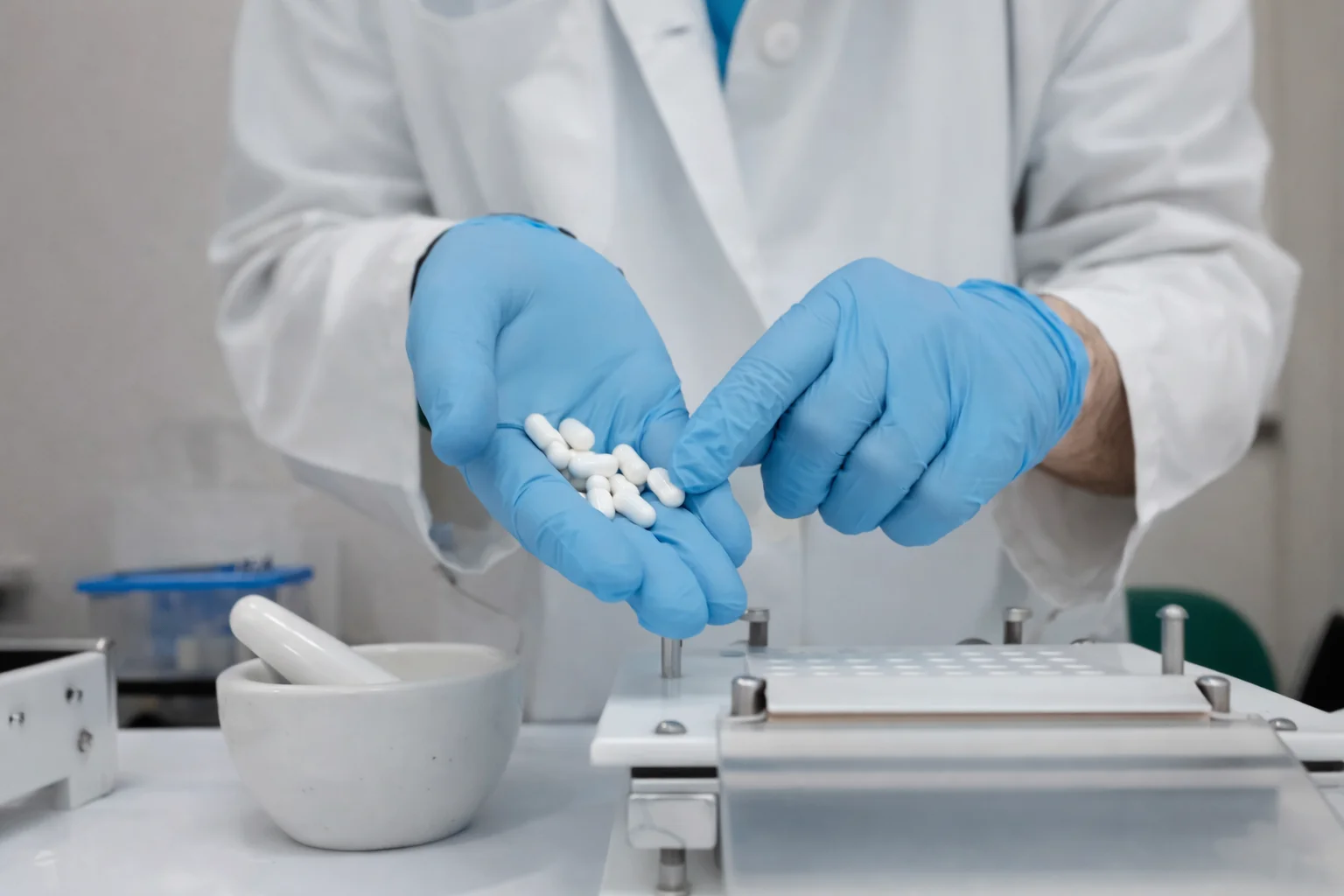
Factory behaviour of the powder is then evaluated. Particle-size distribution is measured by laser diffraction or sieving or image analysis to get D10, D50 and D90, and shape and morphology are viewed by optical microscopy or SEM and surface area by BET. Bulk and tapped density are assessed, along with simple flow indicators like Carr’s index, Hausner ratio, and angle of repose. If the material is tricky, shear-cell testing (ring-shear or Jenike) gives a safer flow number. Because Zone IVb conditions apply, hygroscopicity is also checked by DVS or at 75 percent RH screens so it is known if blends will cake. From these numbers, micronisation or milling settings are selected, a glidant is decided, or movement to wet granulation or roller compaction is made.
Dissolution & Biorelevant Media
Exposure starts with the drug leaving the dosage form properly. Intrinsic dissolution rate (IDR) is first measured with a rotating disk to see the drug-only potential. Prototypes are then tested on USP Apparatus I, II or IV (basket, paddle or flow-through) in simple media and in complex fluids. pH-shift or two-stage tests are run to mimic the stomach-to-intestine transition. Biorelevant media like FaSSIF, FeSSIF and SGF are used to reflect fasted and fed states. Where useful, permeability screens such as PAMPA or Caco-2 are added to judge if permeability, not dissolution, will limit exposure. The curves indicate whether particle-size targets, pH modifiers, surfactants, or enabling routes like amorphous solid dispersions (spray-dried or HME) or lipid systems are needed.
Compatibility (API–excipient)
It is checked whether the API and common excipients can coexist without getting changed. Binary blends are prepared with lactose, MCC, crospovidone, HPMC, buffers, surfactants, and lubricants like magnesium stearate, then they are kept at 40 °C and 75 percent RH and at 50 to 60 °C dry for one to four weeks, and tested by HPLC for assay and impurities. Fast flags are obtained from DSC (peak shifts or new events) and isothermal microcalorimetry. FT-IR or Raman mapping and XRPD after stress are used to catch chemical or form changes. Headspace GC or targeted peroxide screens are run for oxidative grades, and lubricant sensitivity tests are done by varying magnesium stearate level and mixing time to see impact on compression and dissolution. The output is a safe excipient shortlist with allowed levels and grades.
Stress & Stability
The molecule is pushed to see where it breaks, and then protection is planned. Forced degradation is done for hydrolysis in acid and base, for example 0.1 to 1 N HCl or NaOH at 40 to 60 °C, oxidation with 0.1 to 3 percent hydrogen peroxide, thermal holds at 60 to 80 °C in dry or wet conditions, and photostability as per ICH Q1B using UVA and visible light. Because India and export markets are supplied, humidity chambers at 30 °C and 75 percent RH for long-term and 40 °C and 75 percent RH for accelerated, which are the Zone IVb conditions, are used. From these data, packaging screens are run that compare WVTR-relevant packs like HDPE with desiccant versus Alu-Alu blisters, and label and storage statements that reflect reality are drafted. Antioxidants or chelators are also added, process and hold limits are set, and a stability plan that can survive Indian logistics is written.
Injectables
For small-molecule injectables, pH and buffer are first fixed using citrate, acetate or phosphate and tonicity is confirmed by osmolality checks so the product is comfortable on injection. Where degradation is a risk, antioxidants like sodium metabisulphite, chelators like EDTA, or surfactants such as polysorbate-80 are justified and added. Filter compatibility and recovery are verified across common membranes like PVDF, PES and nylon so the dose is not lost in filtration. Particulate limits as per USP <788> are met and visible inspection is performed so the product looks and performs right. Sterility and endotoxin are run as per pharmacopeia because these are non-negotiable. Finally, the container and closure system, often glass or cyclic olefin, is chosen, stopper interactions are checked, and a risk-based extractables and leachables assessment is done. This package gives a sterile, stable, and device-friendly injection.
Biologics (mAbs/proteins)
Identity, Purity, Size and Charge Variants
Identity is confirmed and purity is checked by SDS-PAGE and CE-SDS in reduced and non-reduced modes. Size variants and aggregation are measured by SEC-HPLC, analytical ultracentrifugation (AUC) and dynamic light scattering (DLS). Charge variants are mapped and the pI is obtained by icIEF and cation-exchange HPLC (CEX-HPLC). Where needed, glycans are characterised with HILIC-FLD or MS and the sequence and modifications are confirmed by peptide mapping on LC-MS.
Higher-order Structure and Thermal Behaviour
Folding and unfolding are tracked using DSC and nanoDSF to get Tm and Tonset. Structural fingerprints are recorded by circular dichroism in far and near UV and by FT-IR, and fluorescence spectroscopy is used to see conformational shifts under stress. These tests help temperature limits to be set and subtle damage to be detected.
Aggregation, Particles, Viscosity and Rheology
Subvisible particles are counted by light obscuration as per USP <788> and by micro-flow imaging for morphology. For submicron aggregation, DLS and, where available, AF4-MALS are used. Viscosity and rheology are characterised versus concentration so that the final product can be injected without excess force and without flow issues in devices.

Buffer, Excipient and Container Compatibility
Buffers and pH, including histidine, acetate and phosphate, are screened and ionic strength ranges are set. Surfactants like polysorbate-20 and polysorbate-80 are tested and peroxides and free fatty acids that can grow in storage are monitored. If justified, antioxidants like methionine and chelators like EDTA are added. Filter binding and recovery are measured, adsorption to glass or stainless steel is watched, and silicone oil effects in prefilled syringes are given attention. Early extractables and leachables screens help safer vials and syringes to be chosen.
Forced Stresses (developability)
Freeze thaw cycles are run, agitation by stir or shake is applied, thermal holds typically 25 to 50 °C are used, and light exposure as per ICH Q1B is performed. Isoelectric precipitation and controlled pH excursions are also tried to see sensitivity. Formulations are ranked under these stresses to identify which recipe is robust for shipping and handling.
Potency and Key Impurities
Activity under stress is confirmed by binding ELISA or a cell-based bioassay. Endotoxin is tested by LAL and bioburden or sterility is run per pharmacopeia. Host-cell protein by ELISA and residual DNA by qPCR are monitored. These results protect patient safety and keep the file clean.
What CDMOs Typically Offer in Preformulation
Developability and Solid-Form Work
At the very start, a developability view is usually taken so that weak candidates are filtered out and strong ones are shaped for scale. Polymorph, salt and co-crystal screens are typically run in parallel, and shortlists are produced with clear rankings for stability, manufacturability and expected exposure. A registrable solid form is then proposed with basic control points for moisture, temperature and processing, and with simple guidance on drying, milling and storage. Where IP space matters, a view on freedom to operate around forms and salts is often included. Pilot samples of the selected form are commonly supplied for method set-up and early prototypes.
Solubility and Bioavailability Enablement Screens
Once a workable solid form is on hand, enabling approaches are screened side by side so that time is not lost on single-track trials. Particle-size targets, pH shift systems, surfactant systems, cyclodextrin complexes, amorphous solid dispersions by spray drying or hot melt extrusion, and lipid systems are usually compared using small material. Standard toolboxes are used so that data are comparable across programs, and simple go or no-go rules are agreed in advance. The output is a ranked set of enablement options with material balances, expected yields and a first view of scale feasibility.
Core Preformulation Panels as Decision Inputs
A compact set of decision inputs is generally provided for the formulation team and project leads. Typical readouts include ionisation behaviour, lipophilicity, solubility across pH, early dissolution behaviour in simple and biorelevant media, powder handling numbers, humidity response, compatibility flags and short stress outcomes. These are packaged as design inputs rather than raw data, so that composition ranges, process windows and pack choices can be set without re-analysis. Where gaps remain, quick follow-ups are scheduled instead of open-ended studies.
Early-Phase Enabling Formulations
Fit-for-purpose formulations for toxicology, PK and first-in-human use are usually prepared with short cycles and small batch sizes. Composition and process are often refined with design of experiments so that a stable point can be found quickly. Conditions matching hot and humid markets are included where relevant, and short ICH-style stability sets are started so that dose escalation and shelf-life claims can be supported. Simple hold-time studies and basic filter, container and device checks are commonly added so that clinical supply is not delayed by handling issues.
Integrated Analytics and the DS−DP Handshake
Analytical methods are developed and qualified alongside the study work so that results can move straight into batch release and stability tracking. Transfer between drug substance and drug product teams is planned early, with agreed sample plans, bridging tests and change control routes. For programs that include both small and large molecules, separate streams are kept aligned through common document templates and shared risk registers. This reduces repeat testing and prevents gaps when the program moves from screening to pilot and then to tech transfer.
Typical Deliverables and Ways of Working
Sponsors are usually given a clear report, the supporting data tables and graphs, and a recommended path that pairs the selected solid form with the leading formulation approach. A starter control strategy is outlined with limits and simple justifications, and a practical timeline is provided for prototype manufacture, stability initiation and clinical supply. Governance is handled through regular check-ins, with short decision notes issued after each stage so that scope and spend remain visible. Where external manufacturing or additional partners are involved, interface maps and handover packages are supplied to keep the chain intact.
What is not usually included and how it is handled
Very deep mechanistic studies, broad IP landscaping, and long multi-site stability programs are normally treated as add-ons. When such items are needed, separate scopes are raised with clear milestones. In this way the phase-appropriate model is maintained while critical needs are still met.
How value is realised
The overall aim is to convert small amounts of API and early knowledge into firm choices that stand up in the plant and in the clinic. By giving ranked options, clean limits and a forward plan, rework is reduced, scale-up friction is lowered and the program can move on with fewer surprises.
What Aurigene offers
Aurigene’s preformulation work sits inside an integrated formulation program. Early, structured studies are performed to understand the API, choose the right solid form and excipients, and set a practical path to a robust dosage form. The scope below reflects what is routinely available and executed to regulatory expectations.
- Physicochemical set-up for pKa, logP/logD and molar absorption measurements using pH buffers, solubility rigs and UV/Vis.
- Dissolution lab with intrinsic dissolution fixtures and USP-style apparatus for QC and biorelevant studies
- Bulk characterisation bench for particle-size and shape assessment, bulk/tapped density, compressibility and flowability, with controlled-humidity checks for hygroscopicity.
- Solid-state tools for crystal habit assessment, crystalline versus amorphous determination, thermal behaviour evaluation and monitoring of process-induced phase transformation.
- Stability chambers supporting hydrolytic, pH, oxidative, thermal and photostability stresses under Zone-appropriate conditions.
- Analytical readouts for assay and impurities (for example HPLC) supporting all study streams.
- Physicochemical characterisation: dissociation constant (pKa), partition coefficient (log P), distribution coefficient (log D) and molar absorption coefficient.
- Solubility and stability studies in aqueous and non-aqueous systems, across pH buffers, with solubilisers and excipients, and in biorelevant media (FaSSIF, FeSSIF, SGF).
- Dissolution studies covering intrinsic dissolution, biorelevant single- and two-stage methods and QC media.
- Bulk characterisation establishing particle-size distribution and shape, bulk and tapped density, compressibility, flowability and hygroscopicity.
- Solid-state characterisation defining crystal habit, crystalline or amorphous nature, thermal behaviour and any formulation process-induced phase transformation.
- Stress studies under hydrolytic, pH, oxidative, thermal and photostability conditions.
- Drug–excipient compatibility using mixtures of API with excipients (binary or ternary) from different categories.
- Drug developability assessment using BCS and DCS classifications to identify suitable formulation technology and delivery approach.
- Integration with formulation development so early data feed directly into dosage-form and delivery-route decisions.
- Full coverage of physical, chemical and biopharmaceutical properties to build a complete picture before scale-up.
- Alignment with regulatory expectations and client-specific requirements to support filings and internal decision gates.
- Use of BCS/DCS-based developability to shortlist enabling technologies when justified.
- Linkage of compatibility and stress outputs to process and pack choices to reduce rework and shorten timelines.
- End-to-end orientation—from screening to recommendation—to support a faster, more reliable path to clinic.
Future Outlook of Preformulation Studies
Preformulation decides how fast and how safely a molecule can move into a dosage form that works in patients. Although it looks simple on paper, the practical work is demanding. The sections below outline the future direction of this field.
High throughput Screening with Better Design
Preformulation starts with many unknowns and very little API, so the first need is to compare many options quickly and fairly. Miniaturized rigs and plate based workflows let teams run salt, cocrystal and excipient screens in parallel using small volumes and small masses, across multiple solvents, pH ranges, and temperatures. When these runs are planned with design of experiments, the data reveal which factors matter and which can be parked. Fast analytics such as UHPLC for assay and impurities, XRPD for form, and simple thermal reads close the loop the same day. Results flow into a clear triage so only the few best candidates go forward to larger trials. Thus, we can expect shorter idea-to-prototype cycles and quicker removal of weak options.

Model Informed Choices
Simple models already rank salt forms and predict pH solubility and supersaturation. The next step is to link in vitro dissolution to absorption models so that particle size, pH modifiers and surfactants are chosen with data, not guesswork. A basic Physiologically Based Pharmacokinetic (PBPK) or compartment model can take the dissolution curve, gut pH, transit time and permeability, and show likely exposure for fasted and fed states. For weak acids and bases, Henderson–Hasselbalch based pH–solubility inputs improve these runs. Supersaturation and precipitation risk can be checked with simple nucleation and growth fits or by using IDR and pH shift data to estimate how long the drug stays in solution. For proteins, stability models that relate temperature, pH and ionic strength to unfolding and aggregation help flag risky buffers and stress points. Arrhenius or Q10 style projections give hold limits, and small freeze–thaw and agitation datasets can be used to build simple regressions that warn when particles or viscosity will rise. With this setup we can expect fewer reformulations, cleaner clinical starts and tighter ranges for process and pack.
Closer Link to Manufacturability
Preformulation will connect directly to the plant. Reports will include flow index, bulk and tapped density, Hausner ratio, shear sensitivity from ring shear testing, moisture window from dynamic vapour sorption, and compressibility limits, alongside solubility and solid form. Each number will map to a unit operation setting such as impeller speed, granulation endpoint, drying temperature and time, mill screen size, blend time, and lubricant level. Trial runs at pilot scale will repeat key checks so that the chosen form and particle properties stay intact. This reduces scale up problems and keeps tech transfer steady.
Sustainability by Design
Environmental impact will be considered at the same time as performance. Solvent choice will prefer safer classes and lower boiling points where possible. Water use and energy load during drying and milling will be measured and reduced. Salt or form selections that dry faster or need fewer solvent exchanges will move up the list. Cleaning cycles and solvent recovery plans will be built at the study stage. Packs with proven barrier and lower material mass will be preferred after moisture ingress and light tests. Stability claims will include simple in use instructions that minimise wastage and returns.
Smarter Packaging from Day One
Packaging will be screened in parallel with the formulation. Water vapour transmission rate will be measured against the product’s moisture window. Light protection will be tested with the final dye or pigment load. Headspace control and oxygen ingress will be checked for sensitive products. Interactions with surfactants, plasticisers and silicone oil will be tested for liquids and prefilled devices. Early data will point to HDPE with desiccant, aluminium aluminium blister, or vial and stopper sets that hold form and potency. This prevents late changes to packs and labels.
Integrated Small and Large Molecule Toolkits
Service providers now run both small molecules and biologics, so methods will align where it helps. Risk registers will share a common base with separate branches for oral solids, injectables, and proteins. Screening designs will use the same structure even if the readouts differ, for example dissolution and form for tablets, and aggregation and particles for antibodies. Teams will mix experience so lessons from one platform guide the other, such as humidity control from tablets informing protein fill finish rooms, and container testing from biologics improving injectable small molecules.
Transparent Quality by Design
Preformulation will continue to anchor QbD with traceable evidence. Critical quality attributes and critical material attributes will be set from measured behaviour, not from generic lists. Design space proposals will show how dissolution responds to particle size and pH adjustment, how solid form holds through milling and drying, and how blend flow varies with moisture. Bench data will be confirmed at pilot scale with the same methods. Review packages will present a clear line from risk to test to control, so reviewers can see why each limit and setting was chosen.