


From an Invisible Polymer to a Trustworthy Conjugate: mPEG Alcohols and Activated mPEG Derivatives Development and Manufacturing Services
A lot of advanced therapeutics look simple on the outside. A vial label, a dose, a familiar protein name. Inside, the product can hinge on a quiet ingredient that rarely gets discussed in public, the polyethylene glycol chain that has been attached to a protein, peptide, or antibody fragment to change how it behaves in the body. When PEG is added in the right way, it can slow clearance, reduce aggregation risk, improve solubility, and create a more forgiving dosing profile. When PEG is added in a slightly wrong way, the same program can end up with poor conjugation yields, unstable linkages, unexpected impurities, or a product that cannot be characterized cleanly enough to defend quality.
Methoxy polyethylene glycol, commonly called mPEG, sits at the center of this story. mPEG alcohol, mPEG-OH, is often the starting point. Activated mPEG derivatives are the working tools that make covalent attachment possible. The difference between “PEG present” and “PEG engineered” is mainly a difference in polymer quality, end group control, activation chemistry, and analytical confidence. This is why development and manufacturing services in mPEG alcohols and activated mPEG derivatives matter. They involve producing a reagent that can be used repeatedly, on real biomolecules, under realistic process conditions, while still delivering predictable conjugation and a defensible quality package.
Drug product characterization is a recurring pressure point here. PEG reagents are large, polydisperse materials compared to small molecules, and they behave differently in chromatography, mass spectrometry, and even routine identity tests. At the same time, regulators expect clarity on what is being made, how consistent it is, what impurities can show up, and why acceptance criteria are justified. For PEG reagents and PEGylated drug substances, the technical story must stay stable from early development to clinical supply and then to commercial scale.
Connect with our scientific experts for your drug discovery, development and manufacturing needs
Overview of mPEG alcohols and activated mPEG derivatives
What mPEG means in practice
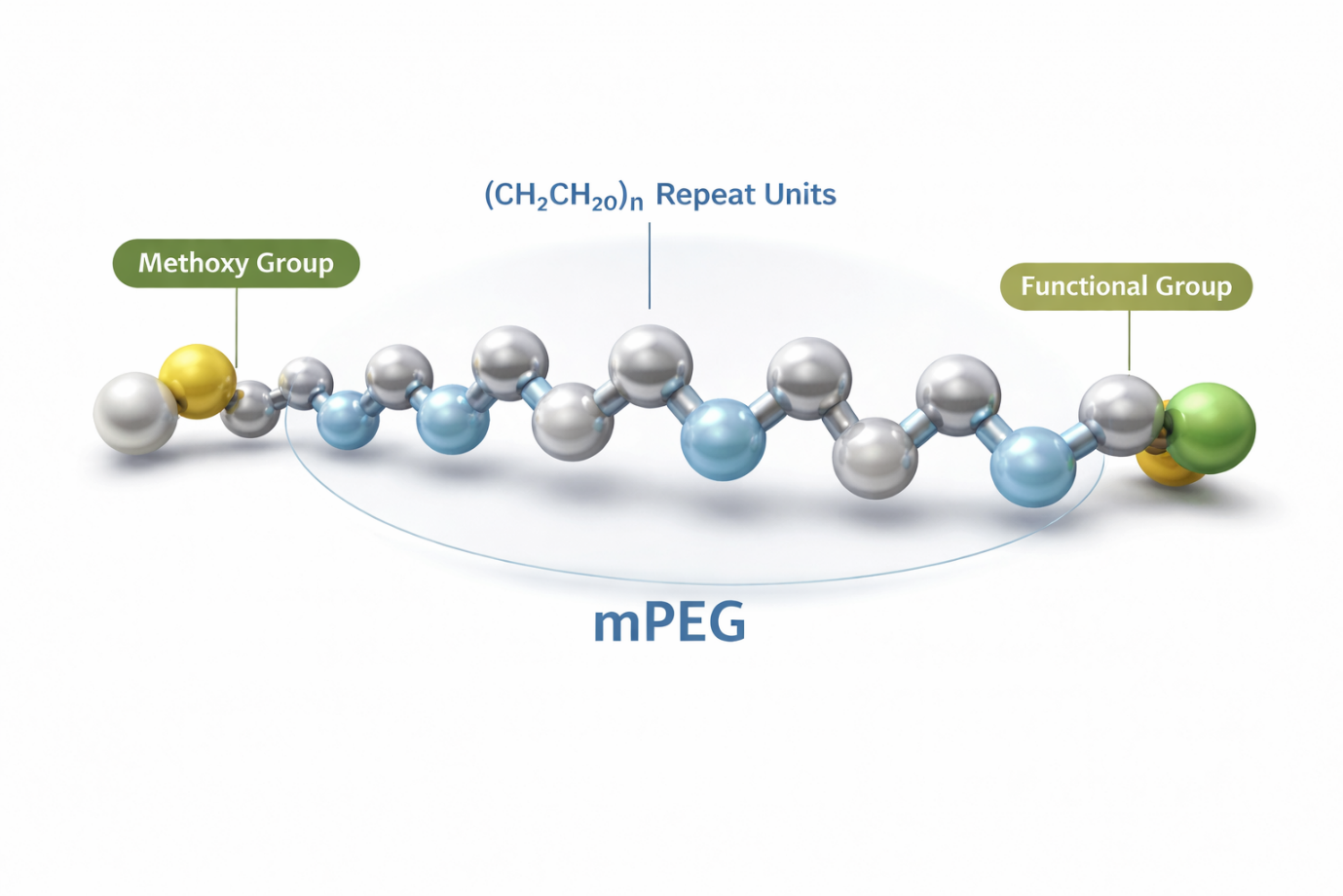
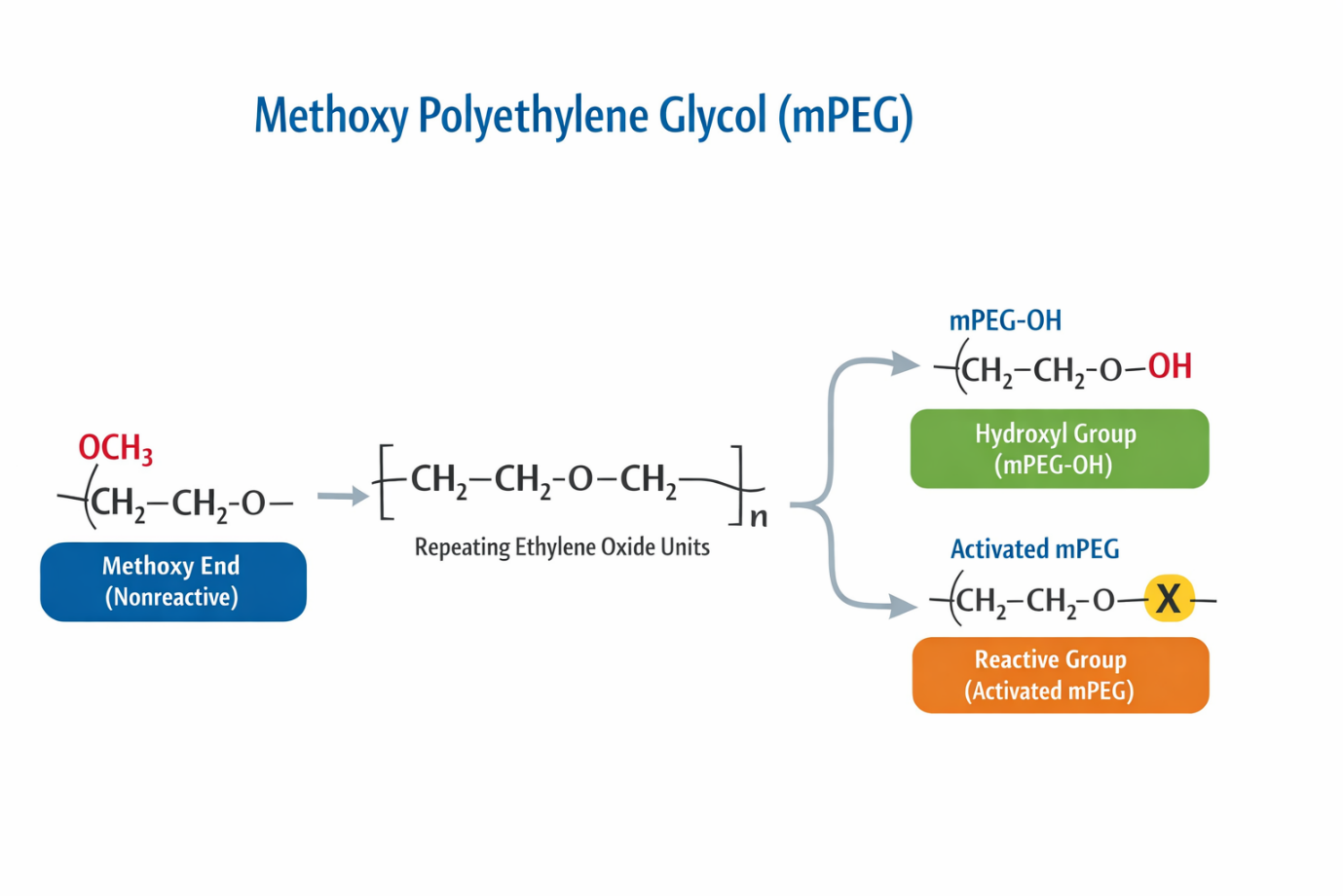
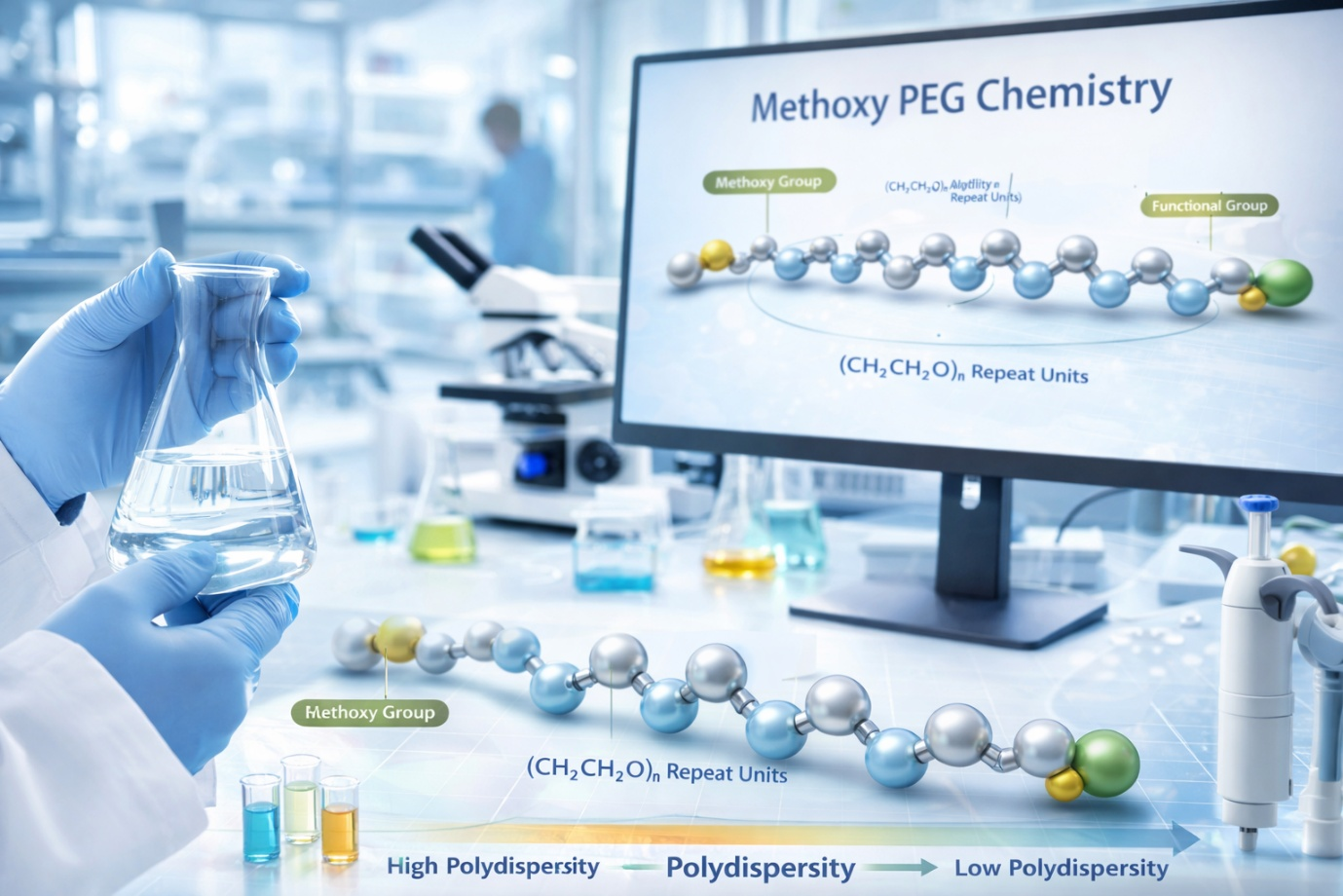
Polyethylene glycol is a hydrophilic polymer made from repeating ethylene oxide units. “mPEG” is a capped version where one end is methoxy, meaning it is chemically blocked and nonreactive, while the other end carries a functional group that can be an alcohol or an activated handle. This simple detail has a big practical impact. A monofunctional mPEG is intended to attach at one point, producing a single PEG chain per conjugation site. If both ends react, crosslinking and uncontrolled architectures become possible, which is usually undesirable for therapeutic conjugates.
mPEG-OH as the foundational raw material
mPEG-OH is the workhorse starting material. It is used directly in some applications, and it is also converted into activated derivatives. For pharmaceutical-grade usage, mPEG-OH is not judged only by nominal molecular weight. The critical questions are whether the molecular weight distribution is consistent, whether the polymer contains low molecular weight fragments that behave like small molecule impurities, whether residual solvents and catalysts are controlled, whether moisture is controlled, and whether end group integrity is stable across storage and handling.
A recurring quality concern is diol content. “Diol” in PEG context usually refers to PEG chains that can behave as bifunctional species due to having reactive hydroxyl groups on both ends. Even small levels can create undesirable branching or crosslinking during activation or during conjugation to a biomolecule. So, low diol content is not a cosmetic claim. It is a structural control measure.
What “activated mPEG” really means
Activated mPEG derivatives are mPEG chains whose reactive end has been converted into a functional group that can form a covalent bond with a specific handle on a protein, peptide, or other substrate. “Activated” does not mean universally reactive; it means selectively reactive under defined conditions. The choice of activation controls which amino acid residues are targeted, what buffer pH is practical, what side reactions can occur, and how stable the linkage will be.
It is common to see multiple activated mPEGs screened for the same molecule. Chain length affects hydrodynamic size, clearance, and sometimes potency. The site of attachment affects activity and stability. The linker chemistry affects long-term integrity. Finding the best combination is often empirical, but empirical work still needs high-quality inputs to avoid false conclusions.
Common activation chemistries and where they fit
Several activation groups appear repeatedly in PEGylation programs and bioconjugation work.
mPEG maleimides are used mainly for thiol-selective conjugation, often targeting cysteine residues. They are valued for fast reaction kinetics under mild conditions, but the chemistry can be sensitive to hydrolysis and to exchange reactions unless linkage stabilization is addressed during process design.
mPEG NHS esters and related active ester systems are used for amine-targeted conjugation, commonly reacting with lysine side chains or N-terminal amines. These chemistries can be efficient, but they can also lead to heterogeneous mixtures if multiple lysines are available and if reaction conditions are not controlled tightly.
mPEG propionaldehyde derivatives are used for aldehyde-based conjugation strategies. These can support more controlled attachment in some cases, but they also bring practical considerations around reaction conditions, reducing agents if used, and side reactions that may impact sensitive proteins.
mPEG iodoacetamides also target thiols and can provide stable thioether linkages, with their own selectivity profile and handling needs.
mPEG thiols and mPEG amines act as intermediates that can be used to build more complex linkers or to connect to other activated systems.
mPEG epoxides can react with nucleophiles under suitable conditions, but they require careful control because epoxides can be more broadly reactive.
DBCO mPEG supports copper-free click chemistry with azide handles, a route often preferred when metal catalysis is unsuitable for sensitive biomolecules. This chemistry is attractive because it can be fast, bioorthogonal, and compatible with aqueous conditions.
Why molecular weight distribution and polydispersity matter
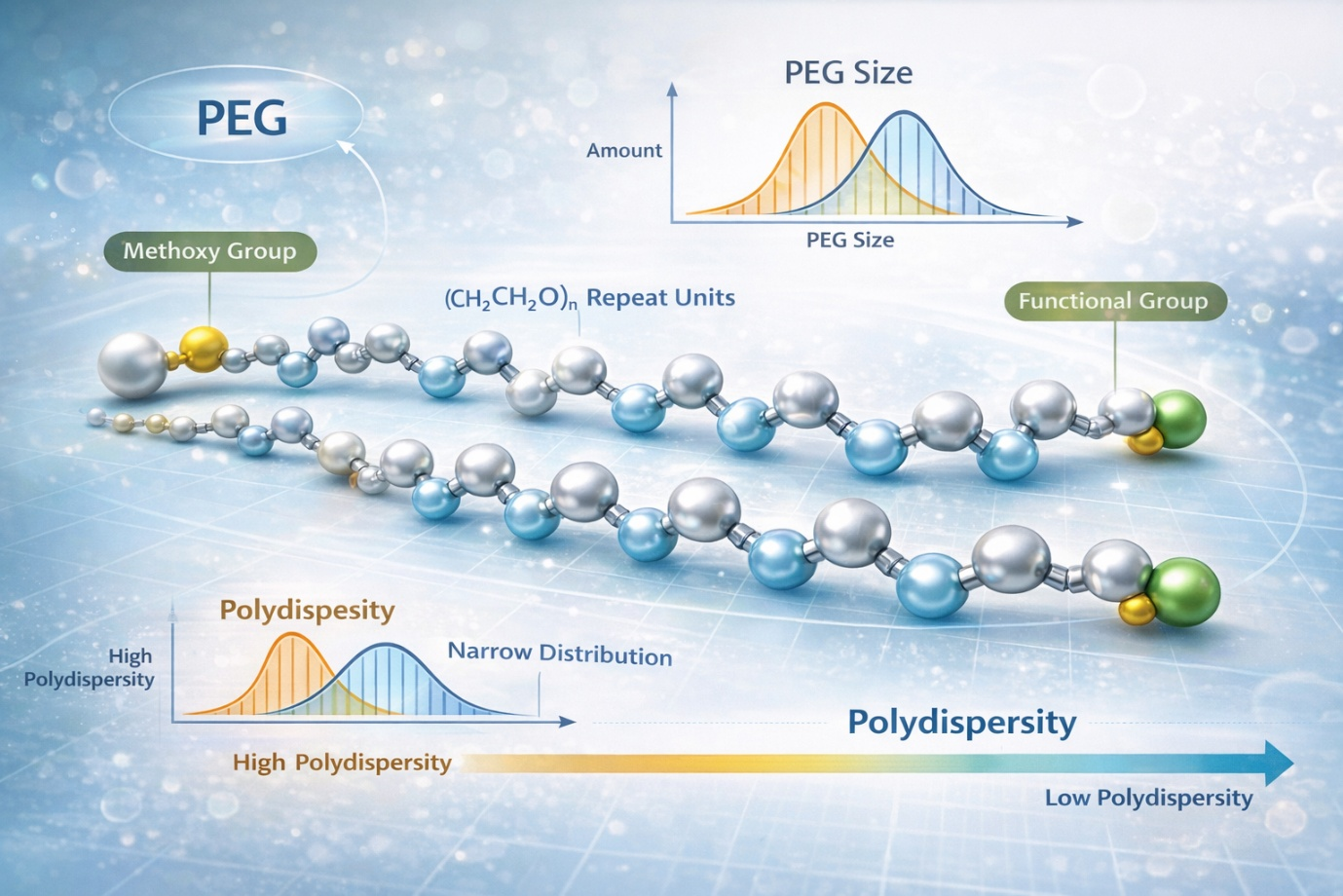
PEG is inherently a distribution rather than a single defined molecule in most standard manufacturing routes. Polydispersity captures how broad that distribution is. A narrower distribution improves batch-to-batch comparability, makes analytical characterization more interpretable, and reduces the risk that the conjugate contains a wide spread of PEG sizes that behave differently in vivo. Polydispersity is therefore not just a spec line. It is a control knob for biological consistency.
Characterization is crucial
Large polymeric materials do not always behave like small molecules in routine analytical workflows. Molecular weight must often be supported by techniques like GPC with appropriate detection and calibration, and identity is usually supported by NMR. Impurity profiling can require tailored HPLC methods, and residual solvents typically rely on GC. Heavy metals and elemental impurities need suitable methods, such as ICP based techniques. The analytical strategy must match the polymer, the activation group, and the intended use.
For activated mPEG derivatives, characterization also includes functionality confirmation and sometimes assessment of activation level. Without this, a “low yield conjugation” problem might actually be a “low activation” problem. In real development work, that distinction saves months.
General Offerings regarding mPEG alcohols and activated mPEG derivatives
Program scoping and target specification setting
CDMOs and CRDMOs typically start by translating an end use into measurable specifications. For PEG reagents, the end use might be a protein PEGylation step for a clinical program, a diagnostic conjugate, or a platform reagent used across multiple internal programs. The specification conversation often covers target molecular weight, acceptable molecular weight distribution, acceptable diol content, moisture limits, residual solvent limits, elemental impurity controls, and the required activation group with its functional performance expectations.
This phase also clarifies what “pharmaceutical grade” needs to mean for the specific context. Sometimes the PEG reagent is treated as a critical raw material, sometimes it is treated as part of the drug substance story because it becomes covalently integrated into the API. The documentation expectations change accordingly.
Route design and activation strategy
For standard activated mPEG derivatives, proven synthetic routes exist, but route selection still matters because activated end groups can be sensitive. CDMOs typically design or adapt the activation route to manage hydrolysis risk, maintain end group integrity, and avoid side products that are hard to purge.
Solvent selection, base selection, temperature control, quench strategy, and workup sequence can decide whether the activated species is stable enough to isolate and store, or whether it degrades during isolation. For some activated groups, a stable isolated solid is realistic. For others, storage conditions and packaging choices become part of the process design.
Process development, scale-up, and robustness work
Once the route is selected, process development usually focuses on reproducibility and scalability. This includes reaction kinetics understanding, impurity mapping, and identification of critical process parameters that influence activation level and impurity formation.
Scale-up can introduce issues that are easy to miss at lab scale, such as mixing limitations, localized heating, moisture ingress, and solvent removal challenges for viscous polymer solutions. CDMOs often use staged scale-up, supported by in-process controls that track activation progress and impurity formation before committing to larger campaigns.
For activated mPEG used in clinical programs, robustness is not optional. Even a small drift in activation performance can change conjugation outcomes and downstream purification profiles.
Purification strategy and control of “polymer-like” impurities
Purification of PEG derivatives is different from the purification of small molecules. PEG chains can trap solvents, show broad distributions, and carry along closely related impurities that behave similarly in many chromatographic conditions.
CDMOs typically use combinations of precipitation, solvent swaps, filtration, and drying strategies tailored to polymer behavior. For some derivatives, chromatography may be avoided at scale due to practicality, and the process is designed to use phase behavior and solubility differences instead. Removal of unreacted starting material and low molecular weight species is a recurring focus, because these species can impact both conjugation performance and regulatory acceptability.
Analytical method development and release testing
Analytical support often runs in parallel with process development. CDMOs commonly develop and qualify methods for identity, molecular weight distribution, polydispersity, impurity profile, residual solvents, moisture, and elemental impurities. For activated derivatives, methods may also include functional group confirmation and, in some cases, assessment of activation level.
Method transfer and method validation become important as programs move toward later stages. A method that works as a development tool may need to be formalized into a validated release method with defined system suitability, precision, and robustness.
Quality systems and regulatory support
For PEG reagents that feed into regulated programs, CDMOs typically support quality documentation, change control narratives, and traceability packages. Depending on the customer requirement, this can include support for regulatory filings where information about the PEG reagent is needed, especially if it is a critical raw material or if a DMF-based approach is part of the control strategy.
A practical point is that PEG reagents can sit at the intersection of chemistry, manufacturing, and biologics expectations. The quality story must therefore be coherent, with justified acceptance criteria and a clear link between process controls and product quality attributes.
Supply models across development, clinical, and commercial needs
Many PEG programs start with gram-scale requirements for screening and conjugation feasibility. They then move to multi-kilogram needs for clinical manufacturing, and later into a steady commercial supply. CDMOs typically support staged supply, with alignment on specifications and comparability strategy as batch sizes and manufacturing sites change.
What Aurigene offers
Aurigene’s scope in mPEG alcohols and activated mPEG derivatives sits on two practical pillars: control over pharmaceutical-grade mPEG-OH through backward integration, and GMP-capable manufacturing of activated mPEG derivatives supported by in-house analytical characterization. Development work is carried out through dedicated capabilities in synthesis, analysis, purification, and troubleshooting of mPEG derivatives, with route design support to incorporate different activation groups and to customize products based on the intended application. Aurigene supports linear activated mPEG across common molecular weights used in PEGylation programs and supplies development and clinical needs.
- Backward integrated manufacturing of pharmaceutical-grade mPEG-OH at the Cuernavaca, Mexico site
- mPEG development at the R and D center in Hyderabad, India
- Activated mPEG manufacturing at Mirfield, United Kingdom, and Hyderabad, India
- Clean room manufacturing suite for medium-scale cGMP chemistry with reactor volume range 1 to 300 L
- Temperature operating range 0 to 150 °C
- Hastelloy hydrogenation or pressure reaction capability up to 20 bar
- Stainless steel filter drier of 100 L capacity, 3 bars
- DCS computer control and heat transfer oil for accurate temperature control
- Annual capacity around 430 kg across variable activating groups
- Scale up of activated mPEG production up to 90 kg per batch
- Development and manufacturing of mPEG-OH with backward integration to key raw material supply
- Support for mPEG-OH molecular weights 2, 5, 10, 20, 30, 40, and 50 kDa
- Custom synthesis of activated linear mPEG derivatives to match end application requirements
- Synthetic route design to incorporate activating groups and manage challenging specifications
- Handling of activating groups, including mPEG maleimides, mPEG pNP carbonates, mPEG propionaldehyde, mPEG amine, mPEG NHS ester, mPEG iodoacetamides, mPEG thiols, mPEG epoxide, and DBCO mPEG
- Support for activated mPEG derivatives across molecular weights 2, 5, 10, 20, 30, 40, and 50 kDa
- In-house analytical characterization and impurity method development with the capability to validate methods as required
- Core analytical testing including NMR for identification, HPLC for impurities, GPC for molecular weight and polydispersity, GC for residual solvents, and ICP OES for heavy metals
- Dual-angle light scattering detector support for high molecular weight determination
- Non-GMP and GMP manufacturing from lab scale to commercial scale with high levels of activation
- US FDA DMF filed for 20 kDa mPEG propionaldehyde and 20 kDa mPEG pNP carbonate
- Backward integration to highly pure methoxy PEG OH for quality control and supply security
- Patent-protected process for high-quality pharmaceutical-grade mPEG-OH
- Specialization in linear activated mPEG
- Narrow polydispersity and low diol content positioning for conjugation consistency
- Ability to address challenging impurity specifications and troubleshooting needs
- Experience and legacy of working with large pharma clients
- US FDA-audited facilities
Challenges and future outlook
Analytical ambiguity in polymer characterization
A core challenge in this domain is that PEGs are not single molecules in most conventional manufacturing routes. Many analytical tools that work cleanly for small molecules give broader, more interpretive outputs for polymers. Molecular weight can be reported as averages rather than exact values, and distribution shape matters. Results can also vary based on method setup, detector choice, and calibration approach. This is one reason why programs often rely on a combination of orthogonal methods rather than a single “gold standard” test.
In practical development, analytical ambiguity becomes a decision risk. A small shift in distribution might be harmless, or it might change conjugation behavior. Without good method control and historical batch understanding, that interpretation becomes difficult.
Functionality drift and hydrolysis risk in activated derivatives
Activated end groups are selected because they react. That same reactivity can create storage and handling vulnerabilities. Moisture, elevated temperature, and prolonged exposure to unsuitable pH can reduce functional performance. For some groups, hydrolysis turns an activated PEG into an inactive PEG that still looks similar in many basic assays, which can lead to confusing conjugation outcomes.
This is why process design, isolation sequence, packaging, and storage conditions are part of the quality story, not operational footnotes. In many programs, a stable, activated PEG supply depends as much on moisture control discipline as on the chemistry itself.
Diol content and unintended crosslinking risk
Low diol content is repeatedly highlighted across high-quality PEG supply because diol species can create multi-attachment events. For biologics, that can mean crosslinked species, aggregation-like behavior, or broad conjugate heterogeneity. Even when crosslinking is not visually apparent, it can still impact yield, purification, and stability.
The challenge is that diol content is not always easy to measure directly with a single simple test, and it can be linked to upstream raw material quality. This makes backward integration and raw material control strategically important for long-term consistency.
Conjugate heterogeneity and the need for clearer control strategies
Even with a well-controlled activated PEG, PEGylation often produces mixtures, especially when lysine-based chemistries are used. A heterogeneous conjugate is not automatically unacceptable, but it must be understood and controlled. As therapeutic programs mature, the expectation shifts from “a conjugate exists” to “the conjugate distribution is consistent and linked to performance.”
This drives the need for better mapping of conjugation sites, better understanding of distribution, and more refined purification strategies. It also increases the importance of reproducible activated PEG performance and consistent molecular weight distribution.
Immunogenicity conversation and the push toward alternatives
PEG has a long history of use, but there is increasing attention on anti-PEG antibodies and their potential impact on some PEGylated medicines. The clinical significance can vary, but the topic is now part of broader risk assessment thinking. This does not mean PEG is going away, but it does mean product developers are becoming more selective about PEG architecture, chain length, conjugation site control, and clinical monitoring strategies.
In parallel, interest in alternatives to PEG and in more defined polymer architectures has increased. Some programs explore more uniform PEGs, different hydrophilic polymers, or designs that reduce repeated exposure patterns. These approaches have their own manufacturing and characterization challenges, but the trend is clear: more control, more predictability, more defendable comparability.
Move toward more defined PEGs and orthogonal analytics
There is a growing effort across the industry to reduce distribution complexity, either through tighter control of conventional PEG manufacturing or through approaches that deliver more defined molecular weights. As this evolves, analytics will also evolve. Multi-detector GPC setups, improved light scattering strategies, and better impurity mapping approaches are likely to become more common expectations, especially for late-stage programs.
For service providers, this means that capability is no longer only about making the polymer. Capability includes interpreting polymer analytics, building comparability arguments, and translating polymer quality attributes into conjugation performance predictability.
More selective conjugation chemistries and more stable linkages
The chemistry toolkit is also shifting toward greater selectivity. Site-selective conjugation strategies are increasingly preferred when they protect potency and reduce heterogeneity. Maleimide thiol conjugation remains widely used, but there is continued focus on linkage stabilization strategies and on controlling hydrolysis and exchange risks. Bioorthogonal click approaches, such as DBCO azide reactions, are also expanding in use where clean selectivity and mild conditions are needed.
As these chemistries move from niche usage to more routine usage, activated PEG supply must also keep up, not only with the right functional group, but with consistent performance and a clear impurity story.
Operational maturity, digital control, and documentation discipline
Finally, the practical future outlook includes more automation and digital controls in manufacturing and analytics, not for style, but for consistency. Batch records, electronic controls, temperature traceability, and better in-process monitoring help reduce variability in polymer processes that can otherwise drift quietly. For regulated supply, this feeds directly into audit readiness and into faster resolution when deviations occur.