


From a single cell to a reliable biologic manufacturing system
Every biologic that reaches patients starts taking shape well before manufacturing campaigns or regulatory submissions. One of the earliest technical commitments happens at the level of the production cell line development. At this stage, a host cell is genetically engineered so it can produce the required therapeutic protein in a controlled and reproducible way. The real goal is not to make the molecule once but to make the same molecule repeatedly, over long development timelines, without unexpected shifts in performance or quality.
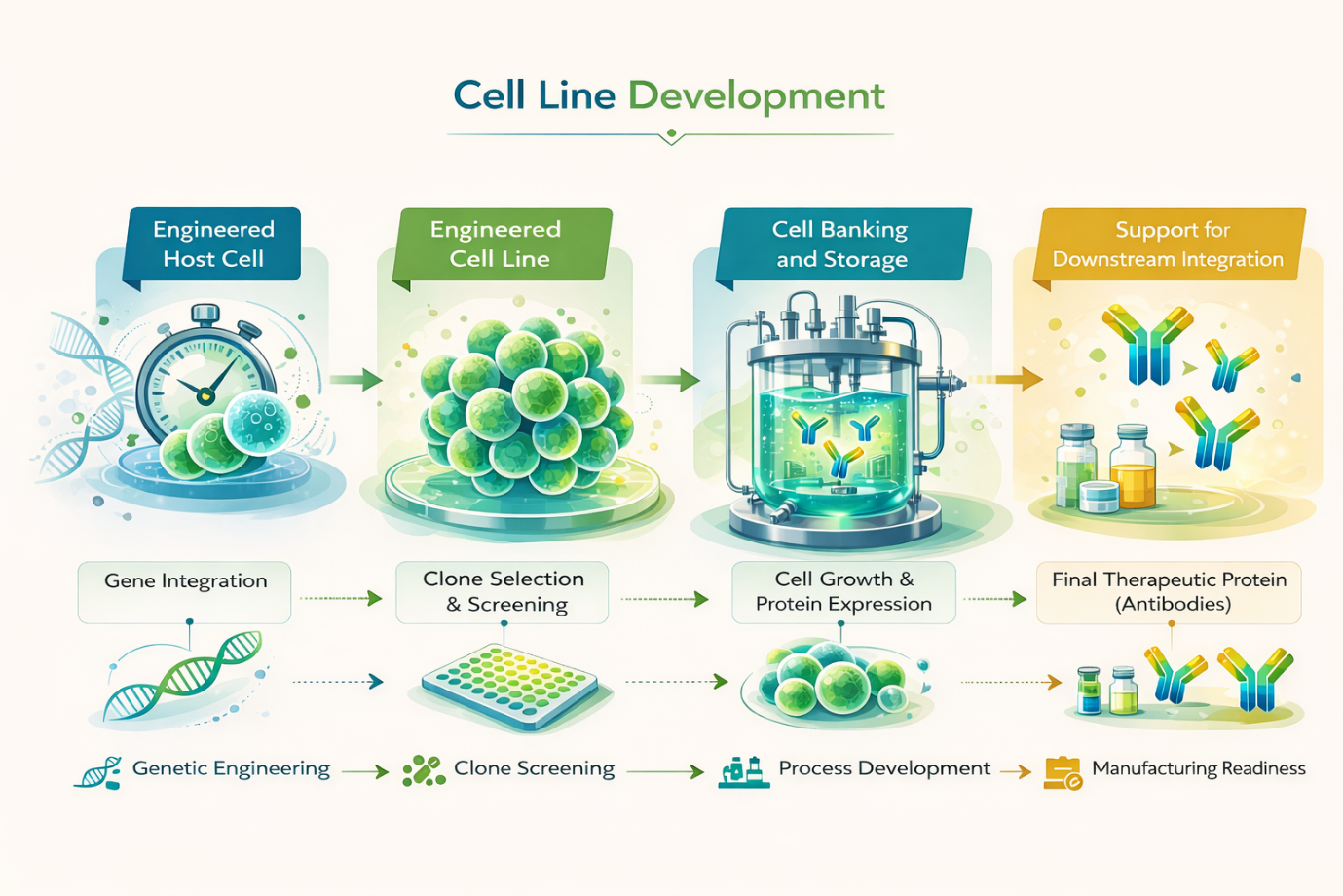
From a scientific standpoint, cell line development is where control over variability begins. How the gene is inserted into the host genome, how many copies integrate, and how the cell regulates expression all influence both productivity and product quality. If these factors are not managed early, problems may arise later as changes in glycosylation patterns, drifting charge variants, higher aggregation, or gradual loss of expression during extended culture. Once a program has progressed into later development, correcting these issues becomes slow, expensive, and often disruptive.
In practical terms, cell line development determines whether a biologic can be produced at yields that support clinical supply and eventual commercial manufacturing. High expression by itself is not sufficient. The cell must also grow consistently, tolerate process stress, and maintain a stable quality profile across generations. Early decisions, therefore, affect batch-to-batch consistency, process robustness, and the ability to handle process changes during scale-up or technology transfer. When early work is rushed or driven only by short-term expression data, the impact is often seen later as declining productivity, unstable critical quality attributes, or difficult questions during regulatory review.
Expectations from cell line development have also increased over the past decade. Biologics are becoming more complex, and tighter control is required over attributes such as glycosylation, charge heterogeneity, and aggregation. At the same time, development timelines have shortened, especially in programs targeting high unmet need. Sponsors now expect development partners to think ahead, not only about small-scale performance but also about how the cell line will behave in larger bioreactors and over long manufacturing runs.
As a result, a cell line is no longer judged only by how much protein it produces. Equal importance is given to how predictable its behavior is, how stable expression remains over time, and how consistently it supports a defined quality profile. In many cases, a moderately productive but stable cell line is more valuable than a highly productive clone that becomes unstable over time.
For many biotech and pharmaceutical companies, CDMOs play a central role in handling this complexity. These partners are expected to deliver cell lines that are scientifically sound and also aligned with downstream process development and regulatory expectations. This requires a development approach that looks beyond early screening results and considers the full product lifecycle. Decisions taken during cell line development must support downstream process development, analytical control strategies, and eventual commercial supply.
In a biologics CDMO setting, cell line development therefore functions as a core platform rather than a standalone activity. It connects molecular design decisions with upstream process development, analytical strategy, and manufacturing needs. When enough rigor and time are invested at this stage, later phases tend to move forward with fewer technical surprises and more predictable regulatory outcomes.
Connect with our scientific experts for your drug discovery, development and manufacturing needs
Science of cell line development
What cell line development means
Cell line development, in day-to-day CDMO work, is the process of turning a gene sequence into a stable production system that can run for years without drifting. It starts with the DNA construct that carries the gene of interest and the regulatory elements needed for expression. That construct is introduced into a host cell, and the result is never uniform. Even when the same method is used, different cells integrate the DNA differently and behave differently. Because of this, cell line development is mainly a structured selection exercise, not a single experiment.
A strong program does not look only at whether the cell can make the protein. It checks whether the cell can make it consistently, with the same quality profile, across repeated passages and under process conditions that resemble real manufacturing. This is where issues like unstable expression, slow growth, higher cell death, or variable product quality start becoming visible. CDMOs also keep the end goal in mind from the beginning. The cell line must be suitable for a regulated environment, which means traceability of materials, clear documentation of decisions, and well-planned cell banking.
Within a CDMO setting, the objective goes beyond basic expression because the cell line becomes the biological foundation for process development, GMP manufacturing, and future comparability discussions. If a sponsor later changes a process parameter, moves to a different site, or scales up from small bioreactors to large ones, the expectation is that the product remains comparable. A stable and well-characterized cell line makes that possible. A poorly chosen cell line makes every later change risky.
Selection of host cell systems
Mammalian host systems are commonly used because many therapeutic proteins need correct folding and human-like post-translational modifications, especially glycosylation. If the molecule needs a specific glycan profile for efficacy, half-life, or reduced immunogenicity risk, the host system choice becomes even more important. Chinese hamster ovary (CHO) cells are used widely because they are well understood, can grow to high densities in suspension culture, and have a long regulatory history in biologics manufacturing. That history matters because regulators are more comfortable when the platform is established and the risk profile is well known.
Other mammalian systems may be considered depending on the molecule. Some proteins express better in particular hosts, and some formats may show quality issues in one system but not another. The choice also depends on the sponsor’s preferred platform, existing process knowledge, and whether the goal is speed, high productivity, or tighter control of specific quality attributes.
The host cell influences growth behavior and metabolism, which directly affects process performance. For example, different hosts may show different tendencies for lactate accumulation, ammonia generation, or sensitivity to shear stress. These factors matter during scale-up and can affect product quality indirectly. Selecting an appropriate system early reduces the need for later corrections and avoids situations where the cell line performs well at small scale but becomes unstable or unpredictable during process development.
Gene integration and expression stability
Stable integration of the expression construct is critical because biologics programs require long-term, repeatable performance. If the gene is not integrated stably, productivity can drop over time, and the program may face delays when stability studies fail. Integration behavior also affects clone-to-clone variability. Two clones can show similar expression early on, but one may drift after several weeks of culture because the integration site is not stable or gene expression gets silenced over a period.
Development strategies often aim to improve on gene copy number and integration patterns so that expression is strong but not chaotic. Higher copy number can increase expression, but it can also increase the risk of genetic instability or cellular stress. If the cell is pushed too hard, it may respond by slowing growth, triggering stress pathways, increasing misfolded protein burden, or producing a less consistent product profile. That is why good programs focus on a balanced outcome, not only the highest titer.
Expression stability is also connected to the molecule itself. Some proteins are harder for the cell to produce because they require complex folding, disulfide bonds, or higher-order structures. In such cases, a clone with extremely high expression may show poorer quality attributes, like higher aggregation or more fragments, because the cell’s machinery is overloaded. A well-designed strategy, therefore, looks for sustainable performance, with steady expression and acceptable quality across an extended culture.
Clone screening and evaluation
After transfection, a large population of cells is generated, and within that population, there is wide variation. Monoclone generation and screening are the steps where a CDMO identifies clones that fit the program’s requirements, not just in productivity, but in growth and quality as well. Monoclone screening usually happens in stages. Early clone screening may focus on basic productivity and growth to narrow the field. Later screening becomes more detailed and looks at stability, product quality attributes, and performance under conditions closer to process development.
Modern CDMO workflows emphasize early data generation because time is always limited. The idea is to learn the right things sooner, so weak clones are eliminated early instead of being carried forward. Structured screening also reduces dependency on trial and error. It introduces predefined criteria, consistent test conditions, and clear decision points. This helps sponsors understand why a particular clone was selected and supports documentation later.
Screening is also where early quality signals are checked. Even at a small scale, it is possible to see if a clone tends to produce higher aggregation, unusual charge variant patterns, or inconsistent glycosylation. Those signals matter because if they appear early, they often become bigger problems during scale-up. A careful screening strategy, therefore, prevents a common mistake, which is selecting the highest producing clone and discovering later that the quality profile is difficult to control.
Cell banking as a regulatory foundation
Once a lead clone is selected, cell banking turns that clone into a controlled and traceable starting point for all future work. A master cell bank is created first, and it acts as the primary reference. From the master, working cell banks are prepared for routine use in development and manufacturing. This structure ensures that production runs are started from a consistent source and reduces the risk of drift caused by extended passaging.
In regulated manufacturing, cell banks are not treated as simply stored samples. They are treated as critical materials with strict requirements for identity, purity, and traceability. Characterization includes confirming the cell line identity, checking for contamination, and performing required safety testing where applicable. Documentation is equally important. Records must show how the bank was created, what materials were used, and how it was stored and monitored.
Well-run cell banking reduces regulatory risk because it supports consistency and reproducibility. If a sponsor scales up, changes a process, or moves manufacturing to another site, regulators often ask whether the same cell bank was used, whether the passage history is controlled, and whether the cell line remains stable. Strong banking practices make those questions easier to answer. They also support smooth transitions into clinical and commercial manufacturing because upstream process development and GMP production can rely on a consistent biological starting point.
General offerings in cell line development by CDMOs
Stable cell line generation
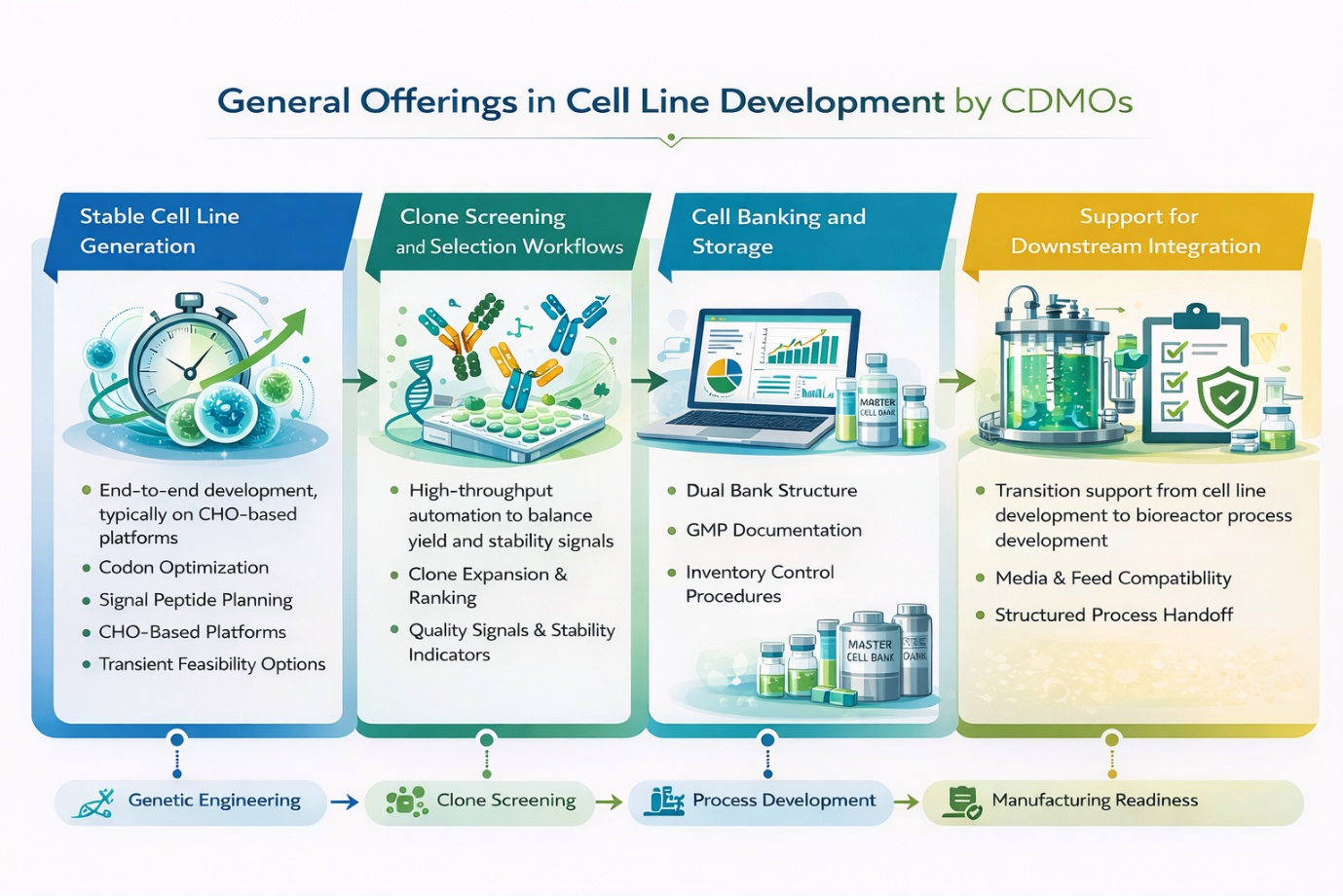
Most biologics CDMOs offer stable cell line generation as an end-to-end service, not as a single lab step. The work usually starts with a sponsor-provided DNA/amino acid sequence or a jointly finalized sequence, followed by construct design checks to ensure the gene can be expressed efficiently in the chosen host. In many programs, support includes practical elements such as codon optimization, signal peptide selection, and vector architecture planning so that expression is strong but still stable over time.
Across the market, Chinese hamster ovary (CHO) cells remain the most common host system for stable expression, mainly because the platform is well established at commercial scale and has a long history of regulatory acceptance. Most CDMOs maintain one or more standardized CHO-based platforms that combine a pre-adapted host cell line, a known vector backbone, and a validated selection strategy. Sponsors generally choose these platforms because timelines and performance are more predictable, and the downstream development path is clearer.
A common market offering is early expression feasibility using transient expression before committing to stable line development. This is especially relevant for complex molecules where expression balance, secretion efficiency, or product quality risk is unclear. Transient material helps confirm that the sequence expresses and gives an early signal on developability, even though it may not fully represent the final stable line product profile.
Many CDMOs also offer options for next-generation formats, where standard approaches may not be sufficient. In such cases, stable line generation may include additional construct engineering and expression tuning so that productivity and quality are balanced, rather than pushing only for the highest early titer.
Clone screening and selection workflows
Clone screening is one of the most differentiated parts of the CDMO service model. The market standard is a staged workflow. Early screening reduces a large clone pool to a smaller set based on growth and productivity. Later screening adds stability indicators and early product quality checks, so that the final selected clones are less likely to fail during process development and large-scale manufacturing.
High-throughput screening is now common across leading providers. Many CDMOs use automation and small-scale culture systems e.g. Ambr 15, designed to mimic fed batch conditions, because clones that look strong in simple shake flask conditions often do not behave the same way under bioreactor-relevant conditions. The purpose of this structured approach is to generate decision-making data earlier and reduce trial-and-error cycles.
There is also a clear market trend toward including quality-related signals early in screening rather than waiting for late-stage analytics. For antibodies, this typically means looking for early indicators of aggregation risk, charge variant patterns, and a first view of glycosylation behavior. For more complex formats, screening may include checks for chain imbalance, fragmentation tendency, or product-related variants/impurities. Some CDMOs also include deeper genetic confirmation steps during clone selection so that the risk of sequence changes or unstable integration is identified early.
Selection is usually based on a balance of factors. A clone with slightly lower productivity but better stability and a cleaner quality profile is often preferred because it reduces downstream risk and improves the chance of a smoother regulatory path.
Cell line characterization studies
Cell line characterization is offered in most CDMOs as a tiered package based on development stage. Early stage characterization focuses on stability trends and basic quality signals that support internal decisions. Later stage characterization expands in depth and is designed to support regulatory submissions and audits.
Genetic stability assessment typically examines whether productivity remains consistent over an agreed number of generations or passages, and whether expression behavior stays stable under defined culture conditions. Depending on the platform and sponsor needs, characterization may include gene copy number assessment, expression monitoring over time, and confirmation that the clone retains its expected behavior during extended culture.
Product quality characterization is often approached in layers. Early work may involve basic profiling that checks whether major quality attributes remain within an acceptable window. As the program matures, the characterization becomes more targeted toward critical quality attributes relevant to the molecule. This is where alignment with the analytical strategy becomes important, because cell line characterization and product characterization must connect logically in the overall CMC story.
From a regulatory standpoint, expectations around cell substrate control and cell banking practices are well established. CDMOs therefore design characterization deliverables so that they are usable in regulatory documentation, including clear traceability of materials, methods, and decisions.
Cell banking and storage
Cell banking is a core offering across biologics CDMOs and is treated as a compliance anchor, not just a storage activity. The typical structure is a two-tier system, master cell bank and a working cell bank. Many CDMOs also create a research cell bank earlier in the development timeline to enable process development and early manufacturing activities without consuming the master bank.
Cell banking services usually include controlled bank creation, defined storage conditions, inventory control, ongoing monitoring, and controlled retrieval. Where GMP banking is part of the offering, the service also includes documentation and testing aligned with regulatory expectations, including identity confirmation and contamination control steps.
The practical reason cell banking is treated seriously is simple. The cell bank becomes the biological reference for the entire manufacturing lifecycle. If issues arise later, or if comparability is questioned after a change, the quality and traceability of the bank often become central to how easily the issue can be resolved.
Support for downstream integration
In the current biologics CDMO market, cell line development is rarely positioned as a standalone service. It is commonly linked to process development (Upstream and downstream), analytical support, and a defined path toward GMP manufacturing. This integration matters because a clone that performs well during screening still needs to perform in bioreactors under controlled conditions, using defined media and feeding strategies.
Support for upstream and downstream integration typically includes a structured handoff into bioreactor-based development, alignment with platform media and feed approaches, and early risk identification for scale-up. Risks can include sensitivity to shear, metabolic behaviors that affect culture performance, or productivity drift when moving from small-scale screening systems into controlled bioreactors.
Many CDMOs aim to reduce discontinuities between early development and later stages by using consistent platforms and standardized workflows. This reduces rework and helps keep the development story coherent across cell line development, process development, and manufacturing readiness.
What Aurigene offers
Aurigene’s approach to cell line development in biologics is built around creating stable and manufacturable systems rather than focusing only on early productivity metrics. The scope is designed to support molecules from early development through later-stage manufacturing readiness.
The emphasis remains on consistency, scalability, and alignment with regulatory expectations, allowing development programs to progress with fewer downstream uncertainties.
- Dedicated mammalian cell culture laboratories
- Controlled cell banking areas
- Integrated process development and analytical support infrastructure
- Stable mammalian cell line development
- Clone screening and selection
- RCB generation and banking
- Stability analysis of clones
- Master and working cell bank generation
- Experience with complex biologic formats, e.g. Monospecific, bispecific, enzyme linked immunofusions etc.
- Alignment with upstream and downstream process development and product characterization
- Focus on early stability and manufacturability
Challenges and future direction in cell line development
Balancing development speed with robustness
Development timelines are getting shorter, but the biology is not becoming simpler. Sponsors want faster DNA to clinic movement, and that pressure directly lands on cell line development. The market expectation today is the quick generation of a usable research bank, followed by rapid movement into process development and product characterization. The risk is that speed-based decisions can push weak clones forward. A clone can look good for two or three weeks and still fail stability later, either through declining productivity or drifting quality attributes.
The practical challenge is deciding what can be accelerated and what cannot. Early steps like pool generation and initial screening can be made faster through automation and standardized workflows. However, stability checks and quality trend checks still need enough time and enough data points to be meaningful. If these checks are reduced too much, the program may gain a few weeks early but lose months later when the clone underperforms in bioreactors or fails comparability expectations after process changes.
A market realistic trend is that CDMOs are trying to build defined, repeatable timelines while protecting key risk control points. Many providers now focus on early-stage indicators that correlate with later performance, so they can move faster without blindly taking risks. Still, the core tradeoff remains. Speed is possible, but only when the screening logic is strong and the acceptance criteria are clear.
Increasing molecular complexity
Newer biologic formats are pushing host cells in ways that traditional monoclonal antibody programs did not. Bispecific antibodies, multispecifics, fusion proteins, Fc engineered variants, and other complex modalities often create higher folding stress, secretion bottlenecks, and a higher risk of product-related variants. In many cases, the cell is not only producing more complex molecules, it is also producing them with tighter quality expectations.
This complexity shows up in several ways. Productivity can be unstable because the cell struggles to handle the expression burden. Product heterogeneity can increase, including changes in glycosylation patterns, higher aggregation tendency, more fragments, or altered charge variant distribution. Some formats also show chain imbalance issues, where one chain expresses more than another, which leads to mispaired species or incomplete products.
At the cell line stage, the challenge is to identify these issues early and not carry forward clones that look good only on titer. For complex molecules, screening must include quality-focused checks earlier than usual, and clone selection often has to prioritize cell health, secretion efficiency, and quality consistency over peak productivity. The future direction in the market is likely to include more modality-specific cell line development strategies rather than treating all molecules like standard IgGs.
Greater use of data-driven decision-making
There is a clear shift toward using more data early in the workflow, not just more experiments. The idea is to reduce uncertainty by capturing stability and quality signals earlier, so clone selection becomes more predictive. In practice, this means using early indicators that correlate with long-term performance, such as productivity trend behavior over passages, early quality attribute patterns, and growth consistency under process-relevant conditions.
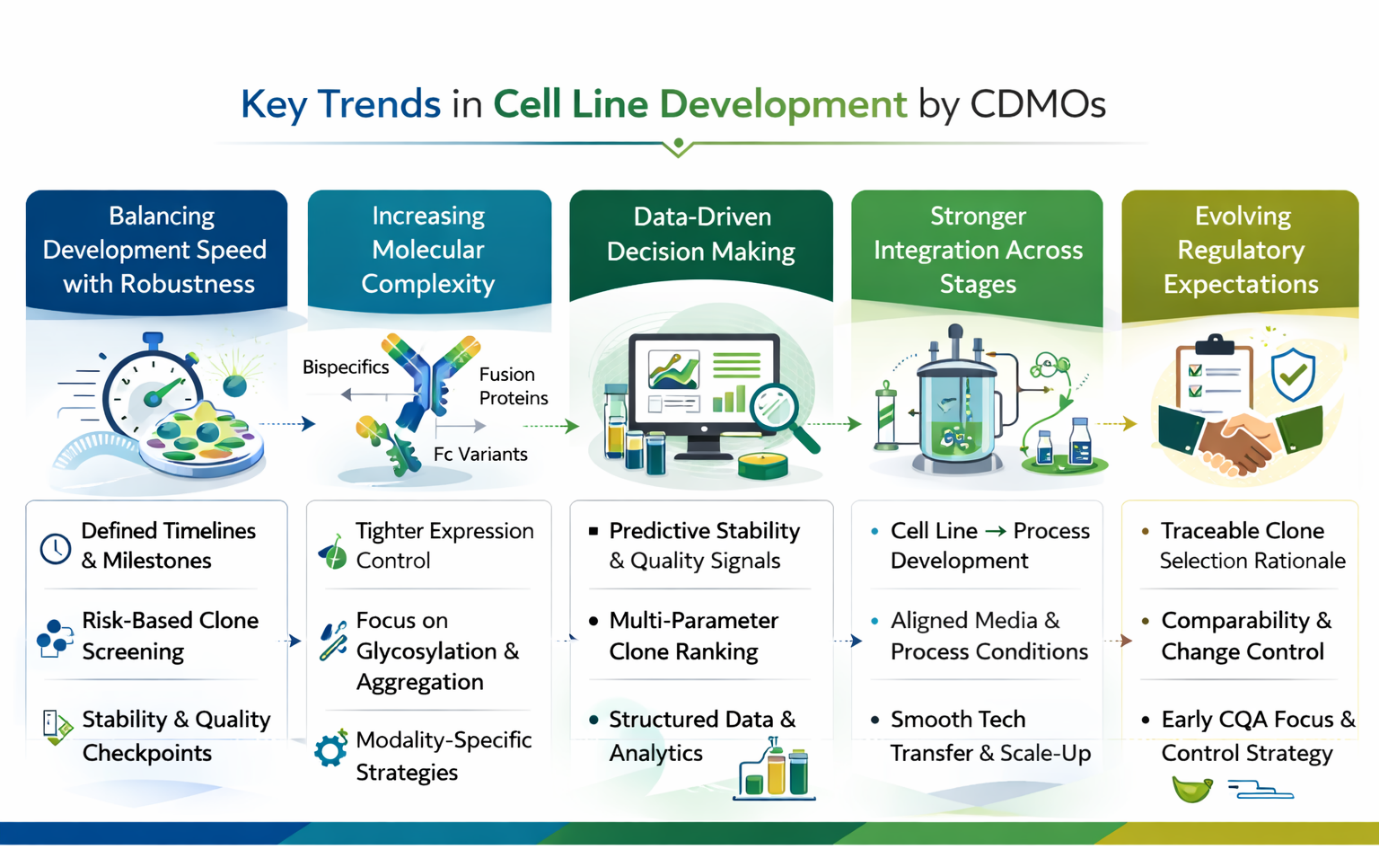
Many CDMOs are also strengthening how they rank and compare clones. Instead of selecting based on one metric like titer, there is more emphasis on multi-parameter scoring, where productivity, growth, stability signals, and early quality data are evaluated together.
Market realistically, not every program can support deep analytics at very early stages, because cost and timelines still matter. The direction is therefore toward smart early data, not excessive early data. CDMOs will likely continue building standardized decision models, using their historical datasets across many programs to understand which early signals are most reliable. This is also where digital tools and structured data capture are becoming important, because it is difficult to improve predictability if data are not captured consistently across projects.
Stronger integration across development stages
Cell line development is increasingly being treated as one part of a connected development chain rather than a separate handoff activity. This is mainly because early cell line decisions directly influence upstream process development, downstream purification behavior, and product quality control strategies. If the cell line produces a difficult quality profile, downstream teams may need extra steps in purification, more complex analytics, or tighter process controls. That adds cost and can slow scale-up.
A market visible trend is that CDMOs are offering integrated packages that connect cell line development with process development, analytical development, and manufacturing readiness. This also reflects how sponsors want fewer handoffs and fewer gaps in accountability. In such models, the clone selection criteria are aligned to the likely upstream platform process, and early data are generated in small-scale systems that reflect bioreactor conditions.
Integration also supports lifecycle management. If a process change is needed later, or if a second manufacturing site is added, a coherent development story becomes essential. When cell line development, process development, and analytics are linked from the beginning, comparability arguments become easier, and programs tend to face fewer surprises.
Evolving regulatory expectations
Regulators expect clear control of the cell substrate and a scientifically justified approach to clone selection and cell banking. This does not mean that every program needs the same depth at every stage, but it does mean that decisions should be traceable and the rationale should be clear. Regulators also expect consistency in how cell banks are created, tested, stored, and used, because cell banks form the foundation of the manufacturing system.
One practical regulatory pressure point is comparability. When manufacturing processes evolve, regulators often ask whether the change affects the product. If the cell line is stable and well characterized, it becomes easier to show that the product remains consistent. If the cell line is poorly documented or shows instability, even minor process changes can become difficult to justify.
There is also an increasing expectation that critical quality attributes are understood earlier, and that control strategies are not developed only at the end. This pushes cell line development teams to think more carefully about quality attributes during clone selection and early characterization, especially for complex biologics.
Where the field is moving
As biologics pipelines expand, cell line development will remain central to how reliably products move from early development to commercial manufacturing. The future direction is likely to be defined by platform standardization combined with modality-specific customization. Speed will continue to be a strong market demand, but the winners in practice will be the workflows that move fast while still protecting long-term stability, quality consistency, and regulatory defensibility. A well-planned cell line development program reduces downstream rework, supports smoother scale-up, and creates a more stable foundation for manufacturing over the full product lifecycle.